The Foundation of The Human Diet
This is Chapter 2 of The Human Diet. You can read the Introduction Here, and Chapter 1 Here.
To get subsequent chapters and other exclusives, subscribe to my free Saturday 7 newsletter where I’ll announce and post the chapters and goodies.
Without further ado, here’s Chapter 2: The Foundation of The Human Diet
Under the pavilion, Kevin waited in line, paper plate in hand.
“How’s dental school going?” Uncle Rick asked, his shirt hugging his beer belly.
Kevin turned, missing his uncle’s eyes, instead drawn to the gaps in his smile. “So far, so good, thanks.”
“That’s great! I think I’m due for a dentist appointment myself,” Uncle Rick said. Kevin wanted to confirm his suspicion. The roots of his front teeth were visible. The bone that was supposed to hold them in was receding away. It was just a matter of time before the periodontal disease would claim several more teeth.
“I’m having some pain in this tooth.” Uncle Rick pointed to one of his few remaining molars. It had a huge silver filling in it. Even though Kevin was just a couple months into dental school, the diagnosis was obvious: a cavity had reached the nerve. He was developing an infection, an abscessed tooth. He’d need a root canal, or, more likely, another extraction. He was headed for dentures. Just like Grandma, hunched over ahead, plopping easy-to-chew baked beans onto her plate.
“Hmm, yeah, I’d get that looked at soon,” Kevin said, deciding to let Rick’s dentist break the news.
Overhearing the dental talk, Jenny, Kevin’s twelve-year-old cousin, spun around.
“I got braces!” she beamed, flashing a smile to show Kevin her blue bracketed bands. But Kevin only saw red, puffy, inflamed gums.
“How are they feeling?” Kevin asked.
“They hurt!” Jenny said. Kevin wondered if she meant her gums or her teeth. “First, they had to take out four teeth—here, here, here, and here.” She pointed to the empty sockets in the four corners of her mouth. “Now these wires are making my teeth ache. Especially these.” She tapped the bulges where her canines sat trapped above the gum line, crowded out from erupting.
“Oh, I bet!” Uncle Rick chimed in. “Casey just got her wisdom teeth taken out,” he said, referring to his daughter’s trip to the oral surgeon. “That’s why she’s not here. She’s been suffering with a dry socket.”
Jenny’s mouth hung open. At first, Kevin thought she was just surprised to hear that was why her cousin wasn’t at the party, but no. She was just breathing. Through her mouth. As usual.
Kevin thought about how dental problems seemed to run in his family. Jenny struggled to breathe through her nose. She had a narrow face, recessed jaws, and forward head posture. Uncle Rick’s teeth, gums, and jawbone were rotting away. Kevin had been there himself. Impacted wisdom teeth. Extractions. Braces. Cavities. Gingivitis. Then a darker thought struck.
It was like they were all descendants of John Frank.
As they snaked through the line, Uncle Rick piled on some potato salad. “Gotta add some healthy food to balance out the chips and cookies,” he joked.
To her own plate, Jenny added watermelon and garlic bread.
Kevin surveyed the spread. For a barbecue, there was shockingly little meat. A measly two-ounce hot dog, the main dish, looked more like a garnish. The sides crowded out the meat like Jenny’s teeth had crowded out her canines.
Kevin grabbed a seat at one of the wooden picnic tables. His eyes drifted to the other mouths and plates. They resembled Uncle Rick’s. And Jenny’s. And his. And nothing like Handy Man’s food- and disease-free teeth. He knew there had to be a connection. That’s what he thought about on the four-hour drive from St. Louis back to Kansas City, back to his dental anthropology class.
. . .
September 9th, 2009
The Dilemma
“Hey,” Kevin said, grabbing his usual seat next to Molly, which was starting to feel more like home than home did.
Molly smiled warmly. “Hi. How was your break?” The expression on Kevin’s face said it all. “Yeah,” she nodded. “I’m glad to be back too.” Something flickered across her face—relief, maybe frustration—but before Kevin could ask what was up, he heard a chair slide out beside him.
“Is this seat taken?” Anna asked. No one had sat there all year.
“Uh, no,” Kevin stammered. “By all means.”
“Thanks.” She smiled at Kevin, tucking a strand of blonde hair behind her ear. Kevin noticed Molly’s subtle sideways glance, jaw clenched. The tension broke when Dr. Whitt entered with a stack of papers in his hands.
“Welcome back! I have presents for you,” he said, flashing a mischievous grin.
“Jason,” he called, grabbing the paper off the top of the stack and waving it overhead. One by one, he called students to pick up their exams. Clearly, Dr. Whitt had celebrated Labor Day by working, grading the Handy Man exam.
“Molly,” Dr. Whitt called. She walked to the front, took her test, and returned to her seat. Kevin got a peek. Perfect score. No surprise.
“Congrats,” he whispered. She hardly looked at him. Just a thin smile.
“Chris.” Dr. Whitt peeled the next exam from the top. Right on cue. Chris had just shuffled into the classroom, looking like he had rolled out of bed about five minutes prior. He stumbled to the front, took his test, shrugged his shoulders, and returned to his desk, placing the test down, then his head on top of it like it was a pillow.
“Kevin.” He stood, grabbed his exam, glanced at the score, and smiled at Molly. But she wasn’t looking.
“Anna.” As she scooted her chair out, she shot Kevin a nervous grin. She returned to her seat with a look of slight disappointment. She glanced at Kevin’s test to compare scores.
“Perfect score?!” she whispered in his ear. “That’s amazing.”
“Thanks,” Kevin said. “How’d you do?”
“I did okay,” Anna replied. “Looks like I made some dumb mistakes, though.”
“It happens,” Kevin reassured her. Instead of looking at her mouth, which had already become a bad habit when talking to people, he found himself drawn into her eyes.
Dr. Whitt finished handing out the exams and said, “I hope you’re all well rested because this next section is my favorite.”
Everyone knew Dr. Whitt was a legend in the field. They were about to discover why. Over his decades-long career, he had devised a unifying theory of The Human Diet. The hypothesis unraveled some of the deepest mysteries of human evolution. But his work came at a price. His groundbreaking publications directly challenged mainstream beliefs. It was why his legacy was mired in controversy. Many scientists refused to even entertain his theory, resistant to abandoning their entrenched ideas, unwilling to admit they might be wrong. Those who recognized the genius and explanatory power of Dr. Whitt’s research were few—a tight-knit minority of specialists. It was why he couldn’t retire. He feared his life’s work would die with him, fading into obscurity—unless he found the right protégé, someone who could carry the torch. The implications were too important.
Dr. Whitt fielded a few questions about the exam, reiterating key points: How Handy Man took the evolutionary fork to humanity. How meat fueled a bigger brain. How that big brain facilitated toolmaking and social cooperation, spinning the flywheel to ever more successful meat acquisition. And how the story was written in his teeth.
“But Handy Man’s story came to an end about 1.5 million years ago,” Dr. Whitt said. “He went extinct. There were several human species offshoots, but one line rose to dominance.”
Dr. Whitt stepped out briefly. Students glanced at each other, unsure what was happening. He returned wheeling in a remarkably complete skeleton. Skull, spine, ribs, limbs, pelvis—only a few bones were missing, from the hands and feet. It stood at almost his height, nearly six feet tall. A sign at the base read: Homo erectus.
“This guy picked up where Handy Man left off.” Dr. Whitt gestured with both hands. “Hunting Man. Arguably the most successful human ever.”
“He lived for nearly two million years,” he continued, “longer than any other human species. If Handy Man forked us onto the path of humanity, it was Hunting Man who then cleared the way.”

Dr. Whitt stopped his slow pacing and stood in place—his usual signal that something important was coming. “In many ways, the foundation of The Human Diet is rooted in Hunting Man. And yet, despite his importance to our biology, most people misunderstand why he was so successful.” He paused, then added, “But, if you remain astute to the clues he left behind, that’s exactly what you’ll discover in this next chapter of the human story.”
He started pacing again. “Over the coming weeks, you’ll need to think like a detective,” he said. “You’ll be going on a scavenger hunt for food clues.”
A few students exchanged looks, single eyebrows raised in disbelief. Was he kidding? A scavenger hunt?
Pleased by the ripple of reaction, Dr. Whitt gave the corner of his mustache a twist. “Your first clue,” he continued, “is right here.” He gestured to Hunting Man’s legs.
“Hunting Man had long legs and a narrower pelvis than Handy Man.” Dr. Whitt spun the skeleton 180 degrees and pointed to the rear of the pelvis. “He had large gluteal muscles.” Then he squatted down, surprisingly low and smooth for a man his age, and pointed to the back of the ankle. “Here’s where an elongated Achilles tendon connected to the heel bone.” He stood up from his deep squat with the ease of someone half his age, and pointed to the base of the skull. “And here—a nuchal ligament.” He turned to face the class. “What do these tell us?”
Kevin and Molly both raised their hands.
“Kevin.” Dr. Whitt nodded.
“They’re all adaptations to running,” Kevin answered. He knew this firsthand. He’d run cross country in high school and his senior year was named team captain. To keep up with the other more naturally gifted runners, he logged over 500 miles that summer while also studying the biomechanics of running. Anything to shave seconds off his 5K race times. He learned that longer legs and strong glutes powered faster times. While he couldn’t do anything about the length of his leg bones, he could strengthen the muscles. He supplemented his runs with squats. He discovered that the alignment of the big toe amplified push-off force—and that, paired with the Achilles tendon, spring-loaded the arches. The foot evolved into a shock absorber, evenly distributing weight and stabilizing each stride. That stability worked in tandem with the nuchal ligament, which anchored the head, and the vestibular system, which helped maintain balance during upright running. Kevin even shaved his body, thinking it might give him an edge. He’d read that humans evolved sparse body hair and over two million eccrine sweat glands for evaporative cooling, a unique human adaptation that prevented overheating on long, hot runs.
“Correct,” Dr. Whitt said. He then pointed to Hunting Man’s shoulder. “And look here,” he continued. “This shoulder anatomy shows a decoupling of muscle function. What does this tell you?”
Molly raised her hand, using the very muscles in question. “Yes, Molly.”
“It indicates adaptations for new motions, like throwing,” she said, suppressing the urge to throw a right hook herself. “Maybe he hurled rocks to defend himself from predators—or to drive them away and steal their spoils. Greater shoulder mobility would’ve made it easier to bash bones for marrow and brain—and eventually, to wield hunting weapons more effectively.”
“Excellent,” Dr. Whitt said. “Like Handy Man, Hunting Man continued evolving away from being a tree climber and fruit picker. At the cost of climbing ability, the muscles around the scapula and rotator cuff decoupled. His shoulder shows the early anatomy that now allows a professional pitcher to throw a baseball 100 miles per hour or an Olympian to hurl a javelin nearly 100 meters.” Molly had experienced that power herself, spiking volleyballs in college.
“As you can see, Hunting Man represents a quantum leap toward modern humanity,” Dr. Whitt explained. “If you ran into Handy Man, you might mistake him for an ape, but run into Hunting Man?” He shook his head. “There’d be no mistake that he’s human.”
Dr. Whitt spun the skeleton 180 degrees again, so he faced forward. “So, Hunting Man here has a big body. He could run and cover long distances. That requires a lot of energy. But that’s not all. Look here.” He pointed to the skull. “He had a huge cranium.”
“Hunting Man’s brain was nearly twice the size of Handy Man’s. Not quite as big as yours, but close.” He tapped the side of the skull. “This big brain posed a big problem. It’s the next clue on your scavenger hunt.” Kevin took note, adding brain size to his list of food clues.
“The brain is energy intensive. Despite making up just two percent of your body weight, it consumes around twenty percent of your daily energy. It’s the most metabolically expensive organ you have.” Dr. Whitt paced, slower now.
“How did he fuel both a big body and a big brain? That’s the next step in your hunt, a critical clue to figuring out what Hunting Man really ate.” He paused. “Was he really a hunter, as his name implies? Or was he still a scavenger-gatherer, like Handy Man? Perhaps just more effective. But if he was a hunter, was he a hunter-gatherer? Or was he a plant-based gatherer-hunter? Or did he evolve as a pure generalist, equally capable of thriving on animals and plants, giving him the flexibility to be so evolutionarily successful?”
The room was silent. Blank stares. Furrowed brows. Puzzled looks.
“Don’t worry,” Dr. Whitt said. “We’ll spend the next several weeks following the clues to solve this mystery. Each clue along the scavenger hunt will bring you closer to the final destination, to the foundation of The Human Diet.”
“Because this is a tough nut to crack, a terrain full of potential missteps, you’ll go with a partner. Together, you’ll collect the food clues and submit a joint project at the end of this section.” A final pause. “Choose wisely.” Twisting his mustache, he grinned—good luck.
As students got up and their chairs scraped back, Kevin felt a touch on his arm.
“Partner for the project?” Anna asked. The request caught Kevin off guard. They’d barely spoken before this. He’d seen her at Teocali’s, but she usually hung out with the more social crowd.
“I, uh—” Kevin panicked. “Okay.”
He didn’t need to see her face. He could feel Molly’s disappointment behind him.
“Great!” Anna pulled out her phone. “What’s your number?” she asked, typing as he recited it. His phone buzzed immediately with her text.
By the time the exchange was over, Kevin turned to catch Molly, but she was already gone.
. . .
That evening Kevin headed to the library.
The post-holiday workload was light, but he figured Molly might be there. He wanted to clear the air about the project situation and catch up on their breaks. As he climbed the stairs, he wondered what Molly’s family was like—she’d never mentioned them, always steering conversations back to coursework. She seemed so put-together, he imagined her parents were probably professors or doctors or something, a dynasty of achievers with perfect teeth.
When he reached the third floor, he rounded the corner to the south-side tables. He saw her—as he’d hoped—sitting at their usual spot. She was typing into her computer while reading from a textbook. Kevin felt mixed emotions. He was anxious to talk, but also relieved that it might soon be over.
He gave a small wave to catch her eye. “Mind if I join you?”
Molly kept typing, seemingly slower than usual, finishing her thoughts, drawing out a long pause. “Sure.”
Kevin slid into the chair next to her. “Thanks.” As he unpacked his backpack, he stammered, “So, about earlier, you know, the project, I—uh…” But before he could finish, his phone buzzed on the table. The screen lit up. A text from Anna. He panicked. Again.
Want to discuss the project tonight?
We can meet…
Before he could finish reading it, he flipped the phone face down. Did Molly see it?
Now even more flustered, he tried to re-collect his thoughts. “Sorry, I would have liked to be your—”
“It’s fine.” Molly cut off his apology.
Kevin knew “fine” meant it wasn’t. He took a deep breath and opened his computer, debating whether to drop it or try again. Then he froze.
In an instant, all the air was sucked from his lungs. Anna.
Their eyes met. His heart stopped. And then—she started walking toward them.
“Hi guys! Do you mind if I join you?” Anna asked.
A pause. A long pause.
Paralyzed, Kevin somehow managed a weak smile and nod. Molly didn’t look up. Her eyes were fixed on her textbook. Anna pulled out the seat next to Kevin. He was sandwiched—by Molly on his right, and Anna on his left—and found it suddenly difficult to breathe.
“This is great,” Anna said. “I had just sent you a message to see if you wanted to meet and discuss the project.” Kevin smiled and nodded, still trying to regain his composure. “I thought we could start by trying to solve the first clue from class today.”
“Okay.” Kevin finally managed to get a word out.
“Great. So, the problem, as I understand it, is that Hunting Man had a big body and a big brain that required a lot of energy. We just have to figure out the diet he ate to fuel it all.”
Having regained some air in his lungs, Kevin said, “I have an idea.” He’d been thinking about the riddle since class. “Hunting Man was built like a runner, a smart runner. So instead of relying on scavenging leftovers, like Handy Man, he was actively hunting. I mean, his name is Hunting Man after all. Between hunts, he surely gathered fruits and vegetables. That would’ve given him more food, more reliability to fuel his big body and brain. It makes sense, right? Lean meat, fruits, and vegetables are the basis of the paleo diet, and Hunting Man survived throughout most of the Paleolithic.”
Meat head, Molly thought, still pretending not to pay attention. She knew this typical narrative was wrong. It was why Dr. Whitt was a legend. Albeit a controversial one. Kevin was clearly oblivious to his unified theory of The Human Diet.
“Makes perfect sense,” Anna said. “Since fruits and vegetables can’t run away or fight back like animals, I think he was probably a gatherer-first, hunter-second.”
Wrong again, Molly thought, finding it increasingly difficult to bite her tongue. Anna was clearly oblivious to the sophisticated chemical warfare waged by plants.
“You know,” Kevin said, “he could’ve been both, a hunter-gatherer and a gatherer-hunter, depending on the season and if hunts were successful or not. A generalist diet strategy could’ve helped him survive, no matter what the biospheric buffet had on the menu.”
“Smart!” Anna nudged him with her elbow.
Molly rolled her eyes and huffed audibly. “Actually, neither is correct.”
Anna leaned forward, looking around Kevin. “Huh?”
“Hunting Man wasn’t the stereotypical hunter-gatherer eating a misrepresented paleo diet,” Molly said. “And he definitely wasn’t a plant-first, gatherer-hunter.”
“Why do you say that?” Anna asked.
“Well, to start, he clearly couldn’t have survived on a low-quality, plant-based diet.”
“Low quality?” Anna interjected, slightly defensive. “I’ve been vegetarian for three years.”
“It’s not a judgment of the diet,” Molly replied. “Our pre-human ancestors like Toumaï, Ardi, and Lucy ate low-quality, plant-based diets. In nutritional ecology, low quality means fibrous. No animal can digest fiber. Well, not on their own.”
“What do you mean?” Anna asked, brow furrowed.
“Animals that rely on fibrous plants for energy have specialized guts housing microbes that ferment fiber into fat.”
I thought a plant-based diet was low in fat, Anna thought to herself.
Molly sensed her confusion. “Leaves, stems, and roots contain little to no fat. But their fermented byproduct is fat, specifically, short-chain fatty acids. That’s how a gorilla fuels its big body on leaves. It turns an energy-poor food into fat, which ends up providing over half its energy.”
“So even though a gorilla eats leaves with virtually no fat, they are, in a way, on a high-fat diet?” Anna said, eyes wide. She was suddenly unsure about her plant-based diet.
“Yes. But here’s the thing. Unlike gorillas, we have greatly reduced large intestines. That’s where fiber fermentation happens in primates. We can get less than ten percent, and more likely, less than five percent, of our energy from fiber fermentation. Look here.” Molly flipped to a page in her textbook that compared Hunting Man’s skeletal anatomy to an ape’s. She slid it in front of Kevin so both could look.
“See the ribs.” Molly pointed to the diagram. “An ape’s rib cage widens as it descends, making room for a large gut to ferment plant matter. But Hunting Man’s rib cage is like ours. It tapers downward, reflecting a smaller gut.”

Anna put her hands on her stomach. Her family’s Mediterranean café had been her second home growing up. Her father, an immigrant from Greece, had opened it in the nineties. It was where he met his wife, who later came on to help run the business. Anna got her blue eyes and blonde hair from her mom, but her olive skin and outgoing personality from her dad. She and her cousins practically lived on Greek salads. Anna had a small gut but frequent bloating and digestive issues. She had never connected the dots, but wondered if this was to blame.
“But wouldn’t a smaller gut mean less surface area to absorb nutrients, making it harder to meet his high energy demands?” she asked.
Kevin sat silent, feeling like a referee to this back-and-forth interaction.
“No,” Molly declared. “Different parts of the gut have different roles. In Hunting Man, the large intestines shrank. But it’s likely the small intestines actually elongated, like we see in modern humans.”
Anna stared blankly.
“Animals that rely on low-quality plant foods for energy need a big fermentation chamber—either a robust large intestine for hindgut digesters like gorillas, or a big stomach for foregut digestors like cows. In contrast, carnivorous animals have smaller stomachs and reduced large intestines. Instead, they rely more heavily on their small intestines to absorb higher-quality food.”
“And high-quality means…not plants?” Anna asked.
“Yes, for the most part. The highest quality foods are animal foods. They’re energy and nutrient dense. Plant reproductive parts—like flowers, bulbs, fruits, and seeds—are moderate quality, but they’re scarcer, seasonal, and often heavily defended with toxins and full of antinutrients that decrease nutrient bioavailability.”
“Toxins?” Anna repeated, her concern deepened.
“Yes,” Molly said. “Plants produce toxins to deter fungi, insects, and animals. Parts critical to reproduction, like seeds, are especially protected.” Molly defended her argument like how she was wanting to defend her territory.
“So Hunting Man’s smaller gut meant he needed a higher-quality diet.” Anna said, summing up Molly’s theory. “But why not just keep the big gut? That would’ve given him more food options.”
“That was the evolutionary tradeoff,” Molly replied. “The gut is metabolically expensive. If Hunting Man had transitioned to a high-quality diet, it would’ve been disadvantageous to maintain a big, energy-intensive gut. By downsizing the microbial fat-producing factory, he saved energy—and opened the door for brain expansion.”
“Okay,” Anna said, still not totally convinced. “I can see how a smaller gut saves energy and demands higher-quality food. But I still think fruit would’ve been the main fuel. It is higher quality, like you said. And our primate ancestors were frugivores. And the brain needs sugar. And it tastes great for a reason!” She fired off point after point after point. Kevin nodded in agreement.
“True,” Molly said, “before branching off into separate lineages, our last common ancestor with modern apes was a fruit eater. But each evolutionary step—from Toumaï to Ardi to Lucy—was a bipedal step away from fruit, precisely because there wasn’t enough fruit. If it were abundant, those ancestors would’ve just…stayed in the trees.”
Anna knew this. They’d covered it last section.
“Then humans took even further steps away from fruit,” Molly continued. “Instead of curved, long fingers built for swinging from branches, humans evolved shorter, straighter fingers and a larger, more powerful thumb—anatomy for gripping tools, not trees. And it wasn’t just the hands. Hunting Man’s big body and shoulder anatomy marked another leap away from arboreal life and fruit-picking. The whole trajectory of hominin evolution was away from tree-climbing fruit-eaters to ground-running hunters.”
Kevin glanced at Anna. It looked like she’d conceded point one, but was still hanging onto the rest of her case.
Molly pressed on. “You’re right. Fruits are higher quality than more fibrous plant parts. But still lower quality than animal foods. And the fruit in Hunting Man’s time was nothing like today’s. It was smaller, less sweet, and seasonal. And a frugivore’s diet is still quite fibrous, which is why they have relatively big guts.”
Anna saw how Hunting Man’s evolutionary adaptations would’ve made it increasingly difficult to compete with true frugivores for seasonal, scarce fruit. And fallback foods like fibrous leaves weren’t a great option for him anymore. Still, she held her ground. “But what about the brain? It needs sugar. And Hunting Man had a much bigger brain. It makes sense that he would need even more sugar.”
“You’re right,” Molly said. “Some of our brain cells require glucose. But ketones can fuel most of them. And the cells that require glucose don’t require you to eat it.”
“What do you mean?” Anna asked. “The body can just…make all the glucose it needs?”
“That’s exactly right. We have no essential dietary need for carbohydrates. Like carnivorous animals, we constantly produce glucose, and we can prioritize its use for the few critical tissues that require it, like certain brain cells. But most tissues can run on fatty acids and ketones.”
“So, you think Hunting Man evolved his big brain by eating animals?” Anna pressed, her tone edged with disbelief.
“It seems most likely to me.” Molly turned to another page in her textbook. “Just look at this chart.” She ran her finger diagonally across the page, from the lower left to the upper right. “It plots brain size against diet quality across primates. The trend is clear: the bigger the brain, the higher the diet quality. If you plot Hunting Man’s brain on here, it would infer the highest quality diet—off the chart. That means animal foods.”
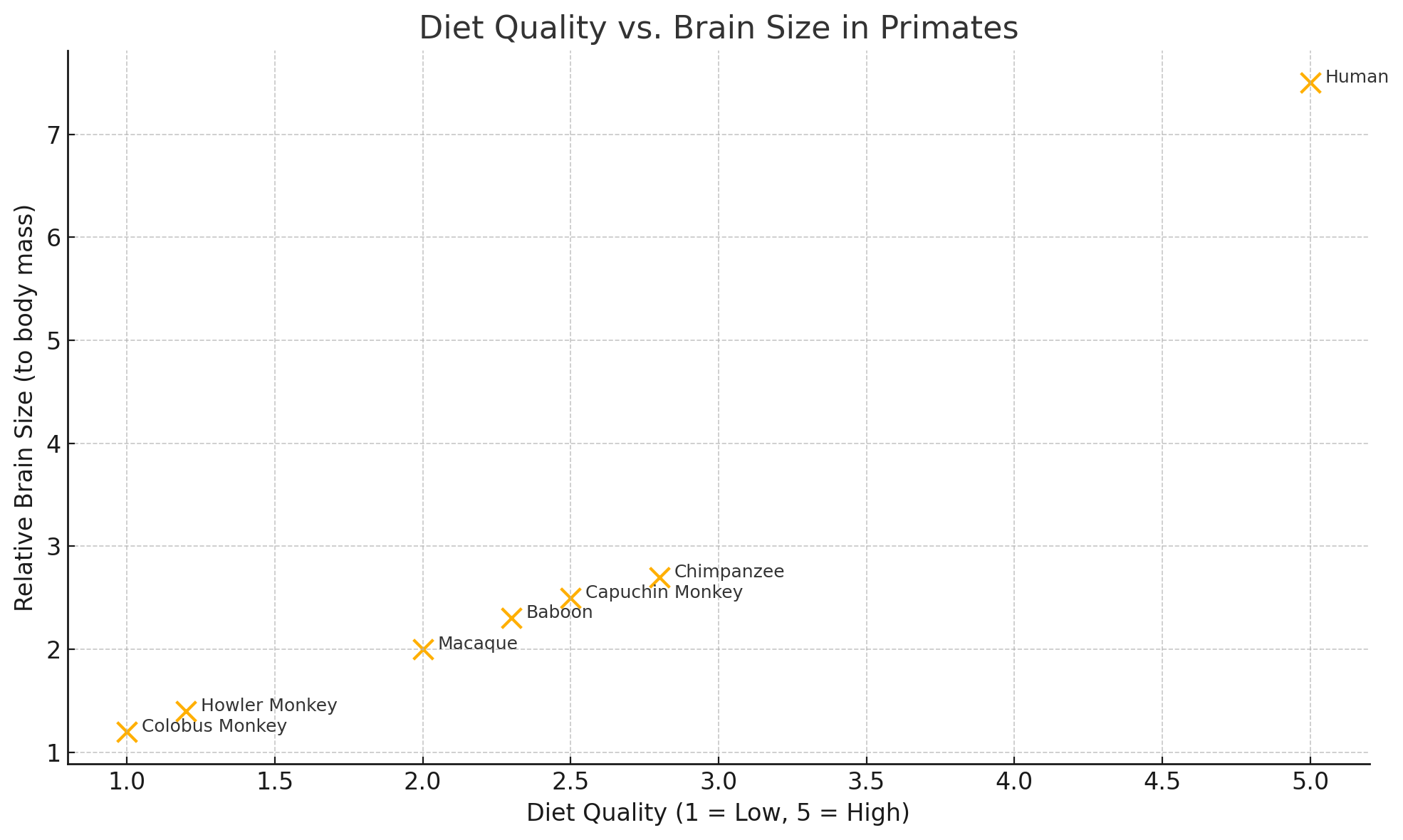
Anna was looking deflated, defeated even. But Molly wasn’t done.
“To your final point,” she continued. “Retaining a sweet tooth as a signal for quick, safe energy was likely an evolutionary advantage. It isn’t something he’d just lose, even if not relying on it. So, I’m not saying Hunting Man never ate fruit or forage, but if we follow the clues, he looks to be built by meat and for meat. Plant foods were no longer primary. Maybe not even necessary. More likely, they became fallback foods and opportunistic adjuncts.”
Having refuted Anna’s points one by one, Molly had made her case. Kevin tried to clarify it. “So, you’re saying Hunting Man was a hunter-gatherer, eating lean meats with some fruits and vegetables when they were available? That sounds like the stereotypical paleo diet…”
“Not exactly,” she said. “Think about it. Hunting Man lost his big gut, the fat-producing factory. Doesn’t it make sense that he’d replace that internal fat production with external fat from food?” Kevin was about to protest before Molly continued. “Taken together, the digestive clues don’t just point to meat. They point to fatty meat. Simple, acidic stomachs—perfect for killing pathogens and breaking down meat. Elongated small intestines—optimized for absorbing protein and fat. A well-developed gallbladder—like that of wolves and lions—stores bile salts to emulsify fat. A well-adapted pancreas secretes protease and lipase enzymes for protein and fat digestion. Meanwhile, Hunting Man’s colon—just like ours—is greatly reduced. He couldn’t process large volumes of fibrous low-quality food. And anatomically, he continued evolving away from fruit. It all aligns.”
Kevin was still sympathetic to Anna’s points, but Molly’s argument was strong, except for the part about fat, which didn’t make sense to him. He was caught in the middle. So he split the difference. “To me, I think Hunting Man, per his name, hunted animals when he could, like a true hunter-gatherer.” Molly felt vindicated; Anna victimized. “But,” Kevin added, “he probably gathered more when the season allowed, or when hunting failed.” Anna warmed to this conclusion. “This makes more sense than relying on animal fats, which we know are bad for your heart.” This time it was Molly about to protest, but Kevin continued. “It doesn’t make sense that we’d evolve to eat something that clogs our arteries. No other animal’s main diet stops their heart!” Kevin laughed at the thought of it. His mom, a cardiac rehab nurse, had ingrained this in his head since he’d been a child. Avoid fatty red meat.
“But we do know fruits and vegetables are good for us,” Kevin continued. “I think a high-protein diet of lean meat, fruits, and vegetables makes the most sense, especially since that’s the basis of the paleo diet after all.”
Molly’s vindication gave way to exasperation. Anna’s victimhood to validation.
Kevin felt like he was trying to walk a tightrope across eggshells. On his left, Anna looked defeated, yet defiant. On his right, Molly detached and done. It dawned on him: he only had so much energy. It was being zapped left and right, not enough to fuel both gut instincts and rational thinking; not enough to split between Anna and Molly. Maybe he, too, would have to make a sacrifice.
. . .
September 11th, 2009
The Bitter Truth
It was Friday afternoon. Class was in the lab. Molly was in her usual seat up front, preparing her notes, methodically licking her finger to turn each page. Anna shuffled down the steps to take her new seat. She dropped her backpack in the empty chair between them, reserving it for Kevin. Molly rolled her eyes. No one had sat in that seat all year. Two minutes later, Kevin arrived. Anna smiled and moved her backpack.
“Thanks,” Kevin said, sliding into the middle seat, wedged between unspoken tension.
As class began, Kevin heard a chair scrape back to his left. It wasn’t Molly. Chris slid into the seat next to her. “Right on time,” Chris said. A minute or two late was early for him. Chris then whispered something in Molly’s ear, making her grin before she turned to face the front again. Kevin felt an unexpected sting.
Dr. Whitt powered on the overhead projector. “Here’s your next food clue.” An image of Hunting Man’s jaw appeared on the screen. “While Hunting Man had a big body and a big brain, he had a smaller jaw.” Kevin frowned. It seemed backward. Paradoxical. Bigger body, bigger brain—that meant more food, more chewing—shouldn’t that mean bigger, stronger jaws?
Dr. Whitt clicked to the next slide: skulls with renderings of muscle attachments. “Before Hunting Man appeared, a frameshift mutation occurred in the MYH16 gene. It reduced the size of the jaw muscles.” Dr. Whitt pointed to a muscle labeled temporalis, which connected the lower jaw to the skull. “This gene modification is in all of us today. It’s a unique marker of the human lineage—and our lost chewing power. Why would nature select for smaller jaws and weaker bites?”
Jason stopped snacking on chips to answer. “A smaller masticatory structure could save energy, not having to build and support bigger facial muscles and bone structure.”
“That’s part of it,” Dr. Whitt said. “If big jaws and strong chewing muscles no longer conferred an advantage, they’d face relaxed selection pressure. Use it or lose it, if you will.” Kevin thought about how that same logic explained the shrinking colon. “This tells us Hunting Man’s diet diverged drastically from that of chimpanzees, who spend half their day chewing. Today, humans spend less than 5 percent of the day chewing. Well, maybe besides you, Jason.” A few people chortled, including Jason. “That’s a lot of energy savings.”
“So, his smaller jaw and weaker chewing muscles meant he wasn’t grazing and grinding on tough vegetation all day,” Jason said. He popped another chip in his mouth, feeling justified in eschewing vegetables for effortless chip chewing—clearly more in alignment with his ancestors.
“Right. But there’s another advantage of a smaller jaw,” Dr. Whitt said. “Anyone?”
No hands. Molly broke the silence. “The weakened jaw muscles allowed for thinner cranial bones, freeing up constraints for braincase expansion.”
“Excellent!” Dr. Whitt exclaimed, happy someone made the connection between a weaker bite and a larger cranium. “And it wasn’t just the jaw that shrank. What else do you see?”
Chris raised his hand. It was odd. He was usually either sleeping or, with rare bursts of energy, blurting out answers. Kevin frowned. Was he trying to impress Molly?
“Yes, Chris, what do you see?”
“Um, the teeth are smaller than Handy Man’s, especially the chewing surfaces in the back.”
“Good,” Dr. Whitt said. “And notice anything about their pattern?”
Chris hesitated. A deer in headlights. Molly stepped in to save him.
“The first molar is the biggest, and the third molar is the smallest, reversing the typical pattern,” Molly said, giving Chris a hand. Chris nodded, acting as if she had taken the words out of his mouth.
“That’s right,” Dr. Whitt said. “Hunting Man’s molars are smaller, reversed in size order, and have thinner enamel. These are all signs of a dietary shift away from tough, fibrous plant foods.”
For Kevin, the clues were converging. The smaller jaw and teeth reflected less chewing. It mirrored the gut’s reduction in size and fermentation capacity. From teeth to tail, the digestive tract told of a decreased reliance on low-quality plant foods. Less chewing, less fermenting. The message was clear: Hunting Man’s diet was high quality. But there was a problem. If Molly was right, and Hunting Man continued to evolve away from fruits, what was left besides animal foods? Perhaps nuts and seeds? But they’re hard and associated with larger teeth and big, strong jaws. Unless he was crushing them up?
“The next clue in your scavenger hunt is so close, you can taste it,” Dr. Whitt said. “If you want to get an A on your project, go outside and start tasting the natural vegetable world.” He paused to soak in the students’ reactions. “I’m joking, of course!” Dr. Whitt belly laughed. “But if you did, almost everything would taste bitter. And bitter is code for danger. It warns of potential toxicity. You have over twenty distinct taste receptors just to detect bitterness—sentinels guarding the body.” Dr. Whitt stood up straight like a soldier standing watch.
“Your ancestors had to trust their tongue. If they came across a wild almond and tasted its bitterness, they’d spit it out. Ignoring the warning could be fatal. Wild almonds contain amygdalin, which breaks down into cyanide—a deadly poison. The almond plant is just one of thousands containing cyanogenic glycosides.”
Kevin froze. He had just finished his muscle bulking phase, eating piles of almonds to gain weight. “I thought almonds were a healthy, natural food?” Kevin asked.
“Ah ha,” Dr. Whitt said, eyes wide. “A common fallacy. If it’s natural, it must be healthy. Rubbish. A handful of castor beans would be your last meal. One bite of water hemlock? Say goodbye.” He waved his hand.
“Your tongue evolved to detect toxins. Plants evolved toxins to protect themselves. Especially their seeds like the wild, raw almond or the castor bean!”
Dr. Whitt saw some confused faces in the audience. “Let me clarify. Plants like grasses, trees, and legumes all produce seeds. These are essentially the plants’ babies. The seeds of grasses are called cereal grains, which include modern staples like wheat, corn, and rice. Tree seeds, in culinary usage, are called nuts: walnuts, hazelnuts, pecans, and yes, almonds too. Finally, the seeds of legumes are beans like soybeans, peas, lentils, and castor beans.
“Terminology can get confusing. For our purposes, they are all just seeds of different plants—their babies. Seeds contain higher-quality nutrition than fibrous, structural parts of plants because this nutrition is intended to nourish a new plant. Trying to steal that nutrition can backfire if you’re not careful. Many wild seeds are bitter for this reason. One taste can trigger gag reflexes and stress responses in your cells.
“Now, herbivores co-evolved with the plants in their dietary niche. They developed specialized enzymes and digestive systems to neutralize plant defenses. We have limited such adaptations. Lucky for us, most mammals don’t try to poison you. They flee or fight.
“So Hunting Man,” Dr. Whitt concluded, “relied on animals to do much of the detoxifying for him. He followed his tongue, his food detector, guiding him to safe choices.
Kevin was starting to doubt seeds played any meaningful role in Hunting Man’s diet. Even if they offered decent nutrition, they shared fruit’s limitations—seasonal, small, and scarce—plus, as the tongue warned, they came with added toxicity risk. His teeth reiterated this conclusion. Hard nuts and seeds require strong jaws and big teeth. But Hunting Man evolved in the opposite direction.
The clues compounded. Hunting Man had to eat a high-quality diet, and yet, he had evolved away from the highest-quality plant options.
The message was echoing louder: animal foods were the only real solution.
But was he just eating lots of lean meat? What else was there…animal fat? Kevin wasn’t convinced. Everyone knew animal fat was bad for you. That couldn’t be the answer. Right?
Kevin’s Notebook:
- After Handy Man came Hunting Man—the most successful human ever.
- He had a much bigger brain and body, which came with much bigger energy demands.
- But his jaws were weaker and his teeth smaller—mirrored by his smaller gut.
- The loss in chewing and fermentation capacity meant he needed a high-quality diet.
- Yet his body kept evolving away from the highest-quality plant foods—fruits, nuts, and seeds— which were seasonal, scarce, and often toxic.
- He was a runner, not a climber: long legs, strong glutes, aligned toes, specialized ligaments and tendons, myriad sweat glands with sparse hair, and shorter, straighter fingers.
- The evidence—from teeth to toes—points to one thing: hunting.
. . .
On the walk to Teocali’s, Kevin saw Chris making large hand gestures, telling some animated story. Molly, Jason, and Rachel were all laughing. Kevin watched as Molly tipped her head back, genuinely delighted by whatever ridiculous thing Chris had said. She was still Molly—still precise in the way she corrected Chris’s mispronunciation of Australopithecus mid-laugh—but there was something unguarded about her, like she’d momentarily forgotten to be perfect.
Even in this state, she and Chris couldn’t be more different.
Maybe opposites do attract?
Chris held the door for Molly, and the group grabbed a table in the back. Kevin and Anna followed close behind, but veered off, taking seats at the bar.
“The usual,” Kevin said to the bartender. He had just started his fat-loss phase for a bodybuilding show. The almonds were already out. The alcohol would have to go soon too, but after the week he’d had, he thought a drink might do him more good than harm.
Anna was talking about something. Kevin nodded along, but his thoughts were elsewhere. Back in time. Running. Chicken breasts. Broccoli. That’s how he’d shed the fat that plagued him in childhood. In fact, he gone too far. Gotten too skinny. Sickly even. To regain his weight, muscle, and energy, he’d had to add carbs and fats back in, usually some grains or nuts. Now, on his current cut, he was back to the old plan: lean meats and vegetables, cardio…plus carbs. Without them, he knew he’d just wither away.
Surely Hunting Man had the same problem? Where did he get energy, if not from fruit and seeds? Surely not animal fat?
Molly, Jason, Rachel, and a few others stood around a table, drinks in hand, laughing.
Kevin and Anna remained off to the side.
“Wanna get out of here?” Anna asked. “We could…continue the scavenger hunt, go look for more food clues…at my place?”
“Okay,” Kevin said. Molly caught sight of them leaving. She took a long sip of her water, focusing intently on something Jason was saying, but her laugh came a beat too late.
As Kevin and Anna walked to Longfellow Apartments, Kevin brought up the dilemma again. Hunting Man needed a high-quality diet, but the high-quality plant foods didn’t work, at least not according to the food clues. Could he have relied on other options? Honey? Fish? Fungus?
This time, Anna was the one nodding along. But her mind was elsewhere—nervous about where the scavenger hunt might lead.
. . .
September 13th, 2009
Office Hours: Optimal Foraging
Notebook in hand, Kevin walked down the vacant hall. Sunday office hours with Dr. Whitt had become as much a ritual as Friday nights at Teocali’s. Kevin looked forward to the time with Dr. Whitt, who also enjoyed prodding Kevin with new perspectives. Over the last couple of months, Dr. Whitt became increasingly hopeful, thinking maybe, just maybe, Kevin was the one. But over the last few weeks, doubt started to creep in. Kevin’s typical laser-like focus seemed diverted. He was distracted. Dr. Whitt wondered if his energy was being split in too many directions.
The door was open. Kevin didn’t need to knock. He walked in and sat in the chair across from Dr. Whitt, who was reclined, reviewing an old paperbound collection of scientific journals, preparing his lecture for Monday. He abruptly closed the book and set it off to the side.
“Kevin! How are you today?” Dr. Whitt welcomed him.
“I’m okay,” he said, noticing Dr. Whitt’s name on the spine of the book. “I’ve been on this scavenger hunt, but some food clues don’t seem to add up.”
“Oh?”
“If I put myself in Hunting Man’s shoes and go searching for wild foods to fuel my big brain and body, I don’t see how I could’ve done it.”
“What do you mean?” Dr. Whitt pressed. Kevin glanced back at the book. Why did Dr. Whitt act so coy about it?
“Well, I assumed Hunting Man was an omnivore, you know, a generalist, who could make do with whatever was thrown at him. I figured he mostly ate a paleo diet, like lean meat from the animals that he was able to hunt, plus fruits, vegetables, nuts and seeds. But as we’ve covered in class, he’d evolved away from fruits. And wild fruits weren’t like today’s. They were smaller, seasonal, and during his two million years in the Ice Ages, he’d have to go through long stretches without them. Other higher-quality plant options, like seeds, had similar limitations, plus added toxicity risks. Surely these were an opportunistic part of his diet, but he couldn’t have relied on them. Depending on seasonal fruits, nuts, and lucky strikes of honey would’ve been like walking a tightrope. One misstep, one unlucky season, and it’s over. And without high caloric yields from grains like we get today, I just don’t see how he survived.”
Dr. Whitt grinned. Kevin was wrestling with the same paradox he had faced earlier in his career—the food clues that eventually led to his unifying theory of The Human Diet.
“I have a food clue for you, Kevin.” Dr. Whitt decided to throw him a bone. Kevin’s eyes widened. “Optimal foraging.”
Kevin shot him an inquisitive look, leaning forward.
“Let this concept guide your scavenger hunt. You must forget what you think you know about the so-called paleo diet. Or about modern-day hunter-gatherers. Or about modern-day nutrition science. Instead, keep putting yourself in Hunting Man’s shoes…well, his bare feet.”
“Okay,” Kevin said.
“You cannot work backward and try to retrofit Hunting Man’s diet into pre-conceived conclusions. You must start at the root, work forward from first principles. Otherwise, you’ll get trapped, falling for any number of half-baked ideas and platitudes like, ‘Hunting Man ate whatever he wanted and whatever he could.’ That’s lazy thinking.”
“But didn’t he?”
“Yes and no. That’s the problem. It’s a grain of truth in a sea of sand. You see, wild animals follow an optimal foraging strategy. They seek out the best payoff in terms of energy, nutrients, and safety, while staying within their ecological and biological constraints.”
“Like every animal has its own instinctual cost-benefit calculator?”
“That’s right. Do you think Hunting Man would expend a hundred calories to dig up and chew a fibrous tuber that yielded 150 calories of usable energy?”
“Maybe.” Kevin thought about it. “If he was starving and there weren’t any other options.”
“Exactly. Even though a deer is a prototypical herbivore, it can occasionally be found gnawing on a carcass. And a polar bear, which is hyper-specialized to hunt seals, will pick at berries, especially when ice retreats. Someone could ‘rightly’ say they eat whatever they can. But that doesn’t tell you about their evolutionary niche, the diet they’re designed to eat to thrive and maximize success. That’s why saying Hunting Man just ate everything is a lazy argument. We want to determine the diet that optimized his success.”
Kevin nodded while Dr. Whitt continued. “To win the scavenger hunt—and ultimately to understand The Human Diet—you must remember: Hunting Man’s adaptations for survival and reproduction were a response to his search for food, shaped by the risks and rewards inherent to his ecological and energetic environment.”
“Got it. I think.”
“It will become clearer as we continue the scavenger hunt in class.”
Kevin got up and started toward the door before stopping. “One more thing.”
“Yes?”
“That book there—you wrote it?”
Dr. Whitt looked conflicted. It was a compendium of his research, his life’s work discarded by academia, bound together—his unifying theory of The Human Diet. He wanted Kevin to search on his own, not to be influenced by his research or biased in his hunt for truth.
“Just some papers I’ve worked on,” Dr. Whitt said, sounding suspicious. The book had an air of intrigue about it.
Since they’d become friendly, Kevin felt comfortable asking, “Can I have a look?”
Dr. Whitt put his hand on the book, looked at Kevin, and deliberated. It was hundreds of pages. Dense. Decades of research. Maybe this would be a true test of Kevin’s passion, he thought. “Sure. Don’t tell anyone.”
Dr. Whitt handed him the book.
“Thanks!”
Off he went, book in hand, to continue the scavenger hunt.
. . .
That night, Kevin grabbed the book and sat at his desk. The cover read: The Unifying Theory of The Human Diet. Unsure where to begin, he flipped to the table of contents. It listed all of Dr. Whitt’s publications. Overwhelmed, Kevin opened to the bookmarked page, the same one Dr. Whitt had been reviewing for class.
It was a paper on optimal foraging, just what Dr. Whitt had told him to focus on. A graph caught Kevin’s eye. It showed the caloric yields of animals based on their size. A large animal, like an elephant, could provide millions of calories, enough to feed a hunter-gatherer group for weeks, if not longer.
For some reason, Kevin had always imagined his ancestors struggling to survive, out on a daily hunt, often returning empty-handed, forced to fast or revert to fallback foods. But if Hunting Man could take down even one large animal, he’d secure food for days on end—more feasts than famine. If he could hunt them. That was the question.
Kevin turned the page. The next chart modeled the comparative energy returns of hunting versus gathering. A simulated hunt yielded thousands more calories per hour than gathering. Even a medium-sized animal offered an energy return an order of magnitude higher.
According to optimal foraging theory, animals specialize in the highest-return items within their niche. That meant Hunting Man would have surely prioritized hunting—if he could succeed.
But Kevin reminded himself: constraints mattered, both ecological and biological. Were there enough animals? Could he hunt them effectively?
It was late. Kevin wanted to keep reading, but he forced himself to close the book. He had class early in the morning.
. . .
September 28th, 2009
Megafauna Monopoly
Dr. Whitt dimmed the lights, a risky move on a Monday morning.
“Once I can get us some funding, we’ll do a field trip,” he chuckled. “But for now, this will have to do.” He pressed a button on the overhead projector remote. A film started rolling, showing an African wildlife preserve—grasses and dirt, trees and brush—a dry yet beautiful landscape full of grazing antelope, zebras, and elephants.
After a few minutes, Dr. Whitt stopped the movie and turned the lights back on. “What did you see?”
The bright lights jolted Chris’s heavy eyelids open. “Animals,” he called out, half-mockingly.
“Right. And more specifically…”
“Um, a lot of antelope,” Chris said, composing himself, remembering he was sitting next to Molly.
“Okay, right. Lots of antelope. In fact, there are ten times as many antelope as elephants here.” Dr. Whitt switched off the film and pulled up a new slide: an image of an old-fashioned weighing scale, the kind with two pans, like the scales of justice.
“Now imagine you gathered all the antelope and placed them on the left side.” He clicked a button. One hundred antelope appeared on the left pan. “Then you gathered all the elephants and placed them on the right.” He clicked again. Ten elephants appeared on the right pan. “This represents the relative numbers of the antelope and elephants.” The scales remained level—for now.
“Let’s have a vote. Which side weighs more: the antelope or the elephants?” He paused to let the class consider.
“If you think the antelope weigh more, raise your hand.” About half the class raised their hands, including Chris, until he glanced to his right and saw Molly’s hand down. His hand wilted halfway to his desk.
“If you think the elephants weigh more, raise your hand.” The other half of the class raised their hands. “Looks like we’re split.”
Dr. Whitt clicked again. The right side, the pan with elephants, dropped, lifting the antelope. “The elephants, though far fewer in number, weigh more than all the antelope combined.” The class broke into chatter and playful jabs.
“Let’s play again.” Dr. Whitt clicked, and the scales cleared and releveled.
“This time, we’re going to keep the elephants on the right, but on the left, add all the other animals.” Click. The ten elephants returned to the right pan. On the left, the antelope were joined by a thousand other species. “Who weighs more now?” Chatter filled the room.
“If you think the elephants weigh more, raise your hand.”
Molly raised her hand. Chris gave her an are-you-serious look, but in a show of support, lifted his hand, barely, chest high. Kevin raised his hand too, thinking back to his reading the night before. Anna gave Kevin the same skeptical look Chris had given Molly. But she kept her hand down.
“If you think all the other animals combined weigh more, raise your hand.” Most of the class did—besides Molly, Kevin, and Chris, whose hand was still midway between up and down.
“Drumroll, please,” Dr. Whitt said, stalling before the reveal. Students tapped on their desks. Click. The scale didn’t move.
“At this preserve, it’s about even!” Dr. Whitt exclaimed. “The biomass of elephants matches that of all the other animals combined.” Chris fist-pumped, like his double-half-vote had nailed it.
Anna couldn’t believe it. “Even with all the poaching and habitat loss?”
“Even so.” Dr. Whitt nodded. “Here, the biomass is about fifty-fifty. But…” Click. “Elephants often make up more than half the total biomass, sometimes up to 80 percent.” The elephant side of the scale dropped, illustrating a four-to-one biomass ratio.
“This is an important food clue,” he continued. “In archeological sites from Africa, Israel, Spain, Germany, and Asia, we see the same pattern. Large animals, known as megafauna—such as the elephant-like proboscideans—dominated the biomass.”
Kevin perked up. This answered the question that nagged at him the prior night about Hunting Man’s optimal foraging strategy. Sure, the largest animals offered the greatest energy returns, but were there enough of these animals? The fossil record answered with a resounding yes. But one question remained: could Hunting Man catch them?
Dr. Whitt interrupted Kevin’s thoughts. “Next.” He clicked back to the film, showing the African landscape. “Did you notice where the elephants were hanging out?”
A whispered mixture of “ponds, water, lakes” filled the room.
“Correct. Elephants congregate around waterholes, drinking hundreds of liters of water a day. Now imagine this: you have an animal that dominates the biomass and congregates in a reliable, repeatable location. It would be a sitting duck for a carnivore—if not for its size, which makes it nearly immune to predation.” Dr. Whitt paused. “That is, until Hunting Man.”
“How do we know that?” Anna spoke out.
“Ah ha!” Dr. Whitt pointed his index finger in the air.
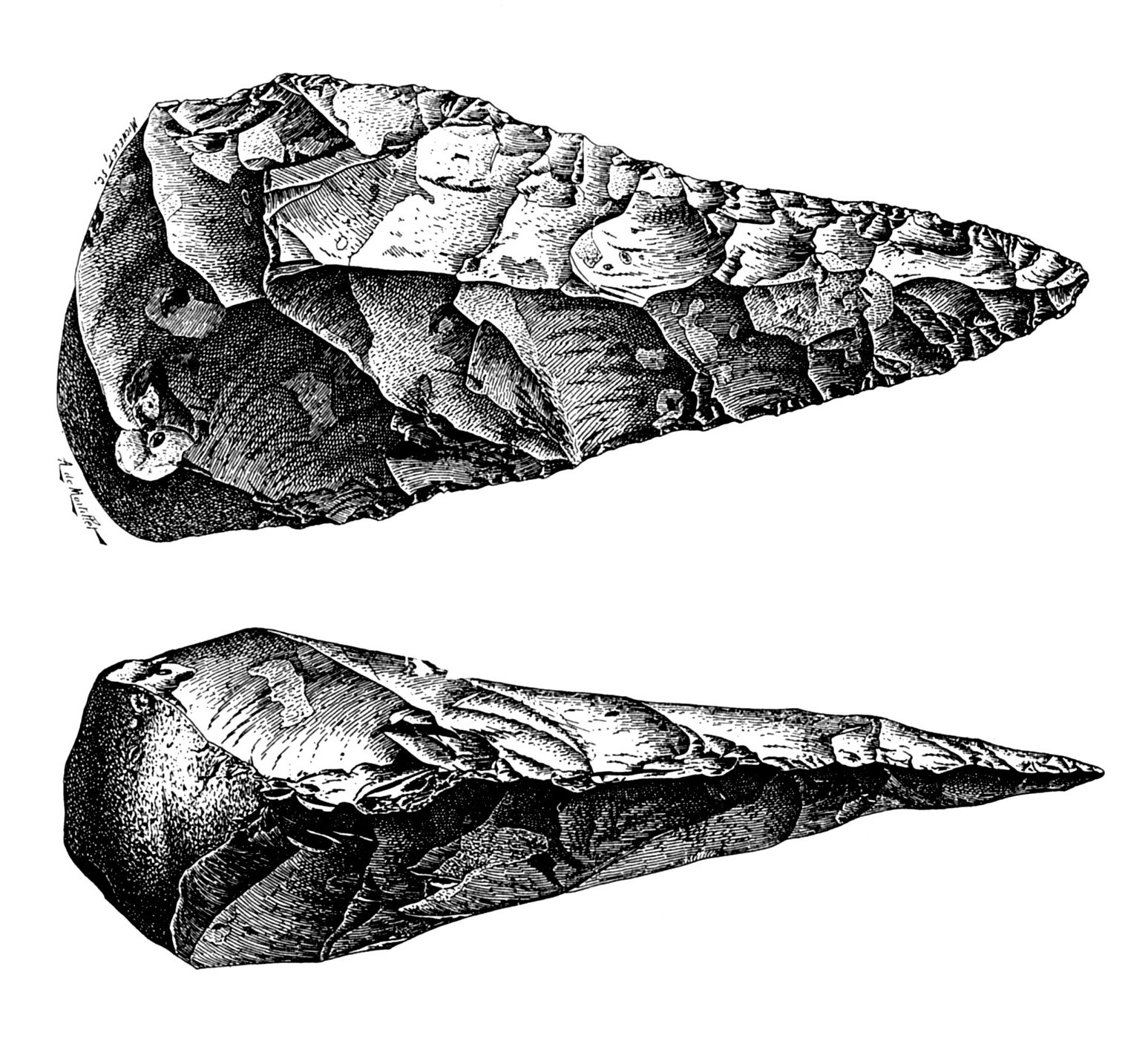
Dr. Whitt moved Hunting Man’s skeleton aside and rolled a new table up front. It was covered in rocks shaped like teardrops. He picked one up. “Aiding his escapades, Hunting Man developed a new tool industry. Unlike Handy Man’s Oldowan tools, which lacked consistent shape, Hunting Man produced these Acheulean tools in a standardized way. Flaked on both sides.” Dr. Whit slid his thumb and forefinger along the double-edged stone. “These large handaxes and straight-edged cleavers were like multipurpose Swiss Army knives: capable of butchering, slicing, and skinning, designed for more effective hunting and processing.
“But couldn’t those be used to crush nuts and seeds?” Anna asked, still trying to justify Hunting Man as a plant gatherer. Kevin had wondered the same until he realized raw nuts and seeds were scarce, small, and often toxic, an unlikely staple food.
“Way to keep pushing back,” Dr. Whitt encouraged her. “Yes, they could. But microscopic analysis of stone tools from sites like Gesher Benot Ya’aqov and Olorgesailie shows they were mostly used for processing meat, and hardly at all for plants.”
Considering the mounting food clues, Kevin increasingly disagreed with Anna’s position, though he admired her conviction. He felt obligated to support her. “But absence of evidence isn’t evidence of absence,” he said.
“You are absolutely correct,” Dr. Whitt beamed, delighted Kevin grasped the important research principle. “Just because you don’t see something, doesn’t mean it wasn’t there. And to Anna’s point, plant remains don’t preserve like bones and teeth.
“It’s why we must consider the totality of the evidence, collecting as many food clues as we can,” Dr. Whitt continued. “Each clue is just that, a single clue. It’s the consilience of clues that will guide our conclusions.”
Dr. Whitt held up the handaxe again. “These tools represent a major leap in technological sophistication from simple stone choppers and flakes, reflecting a parallel leap in Hunting Man’s cognitive ability. They also represent a major food clue, one that links three steps of your scavenger hunt.” He paused to let the students catch up in their notes.
“In the same sediment layers where you find Hunting Man’s fossilized bones, you find his Acheulean tools, and you find the butchered remains of megafauna, their gigantic bones scored by handaxes and cleavers, in patterns consistent with active hunting.”
“By coordinating ambushes and setting traps, he preyed on the unpreyable. As his name suggests, Hunting Man was a hunter indeed.”
As Kevin jotted down notes, he glanced at Anna. She looked discouraged, her gatherer-hunter theory growing less and less likely.
“Hunting Man’s cognitive evolution didn’t just lead to new tools,” Dr. Whitt continued. “The hunting of megafauna created an entirely new social order.
“Most primates stop provisioning once offspring are weaned. Juveniles forage for themselves. But Hunting Man hunted big game. It required skill, cooperation, and coordination. Typical primate provisioning wouldn’t work.”
Molly spoke up. “He would have had to share food with nursing females and dependent children.”
“Exactly. So, unlike other primates, Hunting Man behaved more like social carnivores, like wolves who also have large brains, live in complex social groups, and share spoils with kin. All to increase the odds of successful hunts in open habitats.”
“Let’s follow the food clues,” Dr. Whitt said, summarizing. “Nature offered an abundance of large animals. And unlike other potential predators, Hunting Man could hunt them with relative ease. That gave him a monopoly on megafauna. The evidence is in the faunal record: Hunting Man’s bones, his Acheulean tools, and the butchered remains of megafauna. And,” Dr. Whitt raised a finger, “not only did he hunt megafauna, he specifically targeted the biggest, hardest-to-kill, prime adults.”
Kevin furiously scribbled in his notebook.
It didn’t make sense. Why would he go after the most dangerous prime adults when he could more easily take the young or old? They were still huge, but far easier to kill. Was it a game? A mating display?
Before Kevin could raise his hand to ask, Dr. Whitt concluded the lecture. “That’s your next food clue. Your homework is to go hunt for the answer!” He smirked and twisted his mustache.
Anna waited for Kevin. “Thanks for sticking up for me today.”
“Of course,” Kevin said. “It’s important to turn over every stone, no matter how small or unlikely.”
As they headed down the stairs to the clinic floor, Anna said something about Molly and Chris. Maybe she was trying to play matchmaker, or maybe she was roasting the idea of them as a couple. Kevin didn’t quite catch which; he was still turning stones over in his mind. The food clues all pointed in the same direction. Hunting Man’s optimal foraging strategy would have led him to hunt the largest animals he could safely and reliably secure. The biomass data, faunal record, and tool technology all suggested he was an apex predator.
The confusing part was the practicality of it.
Kevin was dieting for a bodybuilding show. He was eating chicken breasts five times a day—to the dismay of his classmates. He felt confident he could go head-to-head with Hunting Man in a meat-eating contest. Even so, after a couple pounds of chicken, he was stuffed yet still hungry, a strange dissonance where his stomach was full, but his brain still craved more food. Just not more chicken.
And he was losing weight fast. Kevin figured his ultra-high protein diet was fine for the short term, but there was no way he could live on chicken breasts forever. He’d waste away. A buffet of all-you-can-eat chicken breasts wasn’t an optimal foraging strategy. It was a cutting strategy, one designed to burn fat while preserving muscle. It wasn’t a strategy for survival or long-term success. Surely, Hunting Man had another secret source of energy…right?
Kevin’s Notebook
- Optimal foraging means targeting the best payoff in energy, nutrients, and safety—within ecological and biological limits.
- Hunting animals yielded many times more calories per hour than gathering.
- The biomass was dominated by large herbivores, like elephants, which Hunting Man could hunt with relative ease by using coordinated ambushes, traps, and advanced tools.
- Given their abundance, energy yield, and accessibility, optimal foraging theory says big animals were his ideal target. And he had a monopoly on megafauna.
- His Acheulean tool industry left cut marks on megafauna bones and reflected a major leap in both technology and cognition—his behavior resembled social carnivores more than his primate ancestors.
- The food clues continue to converge—from his dentition through his digestive tract—Hunting Man was a big game hunter.
. . .
October 3rd, 2009
Protein Poisoning
Kevin spent the next week absorbed in Dr. Whitt’s research. He carried the book with him everywhere, pulling it out whenever he had a spare minute. His one-track mind annoyed Anna, who felt like fallback food to the main course. But he was on a hunt for the missing piece of the puzzle, a food clue that would make sense of it all. He thought it must be hiding in the curious rationale for targeting prime adult megafauna. Surely, both young and old megafauna offered plenty of reward—and for far less risk than the vastly more dangerous prime adults. But if optimal foraging theory was right, the reward for prime adults had to be worth the added risk.
Although Kevin had made the ritual Teocali stop the night before, to Anna’s dismay, he’d left early to rest up for his Saturday morning scavenger hunt, which began at his desk in the middle of his apartment living room. He flipped to the next paper in Dr. Whitt’s compendium. As he scanned the study, a citation caught his eye: a 1930s paper called Prolonged Meat Diets with a Study of Kidney Function and Ketosis.
His ears perked up.
The next step in his scavenger hunt led to the library basement. Searching the archives, he pulled a printed copy of the paper and started reading.
It began with a preamble about Arctic explorer Vilhjalmur Stefansson. In the early 20th century, he had lived with the Inuit in the Canadian Arctic, adopting their customs—including their diet. In the northern tundra, that meant eating almost exclusively meat. Years later, Stefansson returned to the United States and recounted his adventures. He described the unique diet and the effect on his health, now exceptional compared to when he’d set out. To the shock of many, this diet was largely devoid of fruits and vegetables. Edible plants were nearly nonexistent in the cold, barren landscape.
The medical community didn’t buy it. A near zero-carbohydrate diet, devoid of plant foods, for years on end, was thought to be not only dangerous, but surely deadly. To silence the critics, Stefansson and a fellow explorer, Karsten Andersen, volunteered for a study. Under strict medical supervision at Bellevue Hospital, they would eat nothing but meat for a full year.
Kevin finished the preamble. Now he was getting to the meat of the research.
Early in the study, to the skeptics’ delight, Stefansson got sick, developing diarrhea. The culprit, he explained, was that the meat was too lean. He needed more fat. The Inuit, he said, ate fatty meat, like seal, and would even discard excess lean tissue. Too much lean meat, like only eating rabbits, led to “rabbit starvation,” marked by diarrhea, nausea, and fatigue. The cure was fast and easy—more fat.
So the researchers adjusted the diet to make sure at least 70% of his calories came from animal fat. And that’s when Stefansson’s symptoms disappeared. The rest of the study went without a hitch.
How much protein is too much? Kevin wondered. His protein intake was pushing the boundary that had made Stefansson sick. Some days Kevin would even go beyond it, eating over half of his calories from protein. Although he was tired, he wasn’t suffering from diarrhea. Not yet, at least.
In the study, by the end of the year, both Stefansson and Andersen were in excellent health, mentally and physically. Neither showed any signs of vitamin deficiencies, including the vitamin C deficiency, scurvy. If scurvy were present, it would’ve revealed itself within the first few months in the form of swollen, bleeding gums. Instead, the mild gingivitis Stefansson had developed back in the United States resolved during the study.
The paper went on to discuss concerns about fiber and digestion. Despite the absence of fiber, both men still had well-formed, low-volume stools with minimal odor, and no gas or constipation. That made sense to Kevin. Bacterial fermentation of undigested food, especially fibers, produces gases. And since meat is fiber-free and efficiently absorbed in the small intestine, there’d naturally be less gas and waste.
Digestive issues only arose when their protein intake got too high.
Additionally, both men maintained a stable weight and healthy blood pressure. Andersen’s blood pressure even saw a mild reduction. The researchers couldn’t find any damage or strain on their kidneys. Urine markers were normal. Healthy urea clearance. No sign of nitrogen retention, either.
Their metabolisms ran on fat, putting them in mild ketosis for most of the study. Yet neither man experienced the feared symptoms of prolonged ketosis, like fatigue or cognitive impairment.
Kevin was floored by the conclusions of the clinical trial. Carbs and plant foods did seem to be optional indeed. A diet of fatty meat alone could sustain health.
Was that the secret?
Fat?
Is that why Hunting Man targeted prime adults? Because they carried more fat?
From Stefansson’s experience—and his own—Kevin suspected there was a ceiling to how much protein could be metabolized for energy. Maybe that’s why his brain sent him signals to quit eating chicken breasts even when he was still hungry. The meat was too lean.
Molly had suggested that with less fiber fermentation, Hunting Man could’ve replaced lost endogenous fat by eating fat from animals.
Had she been right all along—like usual?
Kevin climbed the stairs from the basement to the third floor to check if Molly might be there. He wanted to share Stefansson’s story. And concede an I told you so. He turned the corner. Their table was empty. Maybe later.
. . .
October 7th, 2009
Fat Hunters
As students were still chatting and taking their seats, Dr. Whitt launched into lecture, wasting no time. He had a lot to cover.
“So far, you’ve evaluated Hunting Man’s risk-reward options, the cost-benefit analysis of hunting versus gathering, and identified the highest-yielding foods.”
Kevin turned back in his notebook, circling the word megafauna.
“With this knowledge in hand, you turned to the ecology,” Dr. Whitt said. “You pinpointed constraints on food availability, like the seasonality and scarcity of high-quality plant foods versus the biomass of various animals.” Turning forward in his notebook, Kevin highlighted a previous note: According to the faunal record, Hunting Man wasn’t constrained by large animals or his ability to hunt them.
“But even if a food source offers the best energetic yield,” Dr. Whitt said, raising a finger, “and even if it’s abundant—”
Here, he raised a second finger.
“—that doesn’t mean that was Hunting Man’s food of choice.”
A third finger went up. “You must also consider his biological constraints.” He paused to emphasize this important caveat. “If you recall, we’ve been discussing these limitations since the start.” Kevin turned back to the front of his notebook, highlighting an early note: Hunting Man had a reduced colon and masticatory complex. Neither his mouth nor gut were designed for low-quality vegetation. He needed a high-quality diet to feed his big brain and his big body. But he evolved away from the highest-quality plant foods—like fruits, nuts, and seeds.
“Now, there’s one final biologic constraint you need to consider on your scavenger hunts,” Dr. Whitt said, in a tone suggesting that this was a major point. “It’s the food clue that reveals why Hunting Man targeted prime adult megafauna.”
“To uncover this clue, let’s first re-visit Handy Man.” Dr. Whitt pulled out the old, familiar skull. “He scavenged carcasses. Broke open bones. Extracted fatty marrow and brains. But he didn’t do this randomly. He was selective, choosing bones in direct proportion to their estimated energy yield—just as you’d expect of an optimal foraging strategy.
“Now, imagine you’re Hunting Man. You have to choose between hunting an elephant or catching a rabbit. The elephant is massive, visits predictable locations, and is relatively slow. The rabbit is small, unpredictable, quick.” Students nodded. The choice was obvious.
“Besides how difficult it is to catch rabbits and the small reward you’d win even if you did,” said Dr. Whitt, “there’s another problem with small, fast animals. Any guess?”
Recalling Stefansson’s account of rabbit starvation, Kevin chimed in. “They’re too lean, mostly protein and not enough fat. There’s a biological constraint with how much protein we can eat.”
Molly looked over at Kevin, surprised.
“Oh, excellent!” Dr. Whitt said. The word came out with a mirthful satisfaction that he could scarcely hide from the class. So you’ve been reading up, he thought, amused. You’re passing the test. “If you eat protein over and beyond what the liver can metabolize and what the kidneys can excrete, you get a toxic buildup of ammonia and urea. Protein poisoning. If we assume Hunting Man had a similar protein constraint, he needed a significant portion of his diet to be either fat or carbohydrates.”
“So, too much meat is a problem,” Anna said. She smiled, clearly reassured in her beliefs that a meat-heavy diet was harmful. “But if he had an easy, reliable source of plant carbs, the protein limit wouldn’t be a problem.”
“Great point,” Dr. Whitt said.
“But in the absence of plant-based energy, he would need fat—a lot of it,” Kevin countered. Molly gave him an even more surprised look than before. “This necessary quantity of fat is only found in large animals. That’s why he targeted megafauna.”
Anna wore a look of betrayal, but Kevin continued anyway. “So, Hunting Man either didn’t have access to enough energetically profitable plant carbohydrates. Or he preferred animal fat. Or both.”
There was a moment of silence in the room. Even Dr. Whitt was taken aback. Breaking the silence, Kevin kept on: “And megafauna have the most fat, both on a relative and absolute basis. Prime adults have the absolute most. Otherwise, targeting the more dangerous prime adults wouldn’t make sense.”
“I agree,” Molly said, supporting Kevin. “It would be unusual behavior. Cursorial predators typically target young and old prey because they’re easier to kill.”
Now it was Chris whose expression bore a tinge of jealousy. Molly didn’t notice. “But if Hunting Man had a biological limit on protein, and ecological limits on plant-based carbohydrates, then he had to hunt for fat.”
Kevin picked up where she left off. “Handy Man selected long bones for their fat. Hunting Man selected prime adult megafauna for their fat.” He glanced left, Molly right, making eye contact. They were aligned. To their right and left, Chris and Anna felt on the outside.
“Compelling argument,” Dr. Whitt said, twisting his mustache. “Hunting Man left his mark on megafauna. He also left it on our biology today. Consider our fat.” Dr. Whitt patted his belly.
“The general pattern among primates and most mammals is that those with bigger brains carry less body fat, and vice versa: smaller brains, more fat. But humans store relatively large amounts of body fat and have bigger brains than any other primate. We’re outliers at both extremes. Our fat cell morphology and metabolism help explain this radical trend reversal.
“Compared to predominantly herbivorous mammals, we have more but individually smaller fat cells—a pattern typical of carnivores. This enables rapid fat mobilization and fits a feast-or-famine survival strategy. Unlike herbivores that graze all day, we can eat intermittently, even surviving about a month without food by living off our fat.
“But, unlike other carnivores, like cats, who have the metabolic machinery to eat leaner prey with higher proportions of protein, we have a protein ceiling.”
Kevin, still thinking about his high protein diet, raised his hand. “If Hunting Man relied on animals, why wouldn’t the forces of natural selection favor higher protein limits?”
“Consider the ecology,” Dr. Whitt replied. “Hunting Man had a monopoly on megafauna, the largest, fattest animals that dominated the biomass. Fat was abundant. It was the path of least resistance. Well, at least for the time.” Dr. Whitt winked, hinting that this wasn’t always the case. “Hunting Man didn’t have the evolutionary pressure to increase his protein metabolism. Instead, natural selection favored fat hunting, fat storage, and metabolic tuning to fat.” Kevin nodded, but Dr. Whitt could tell he wasn’t quite there yet.
“This is reflected in our unique ability to easily enter ketosis, a metabolic state that produces ketones as a result of burning fat,” Dr. Whitt explained. “In fact, we’re one of the few species that can enter and sustain deep ketosis while remaining weight-stable, and even while gaining weight. Ketone bodies can fuel the brain and replace glucose as an energy source in most organs.”
“So, we carry lots of fat to support ketosis and our energy-hungry brains?” Kevin asked.
“Exactly,” Dr. Whitt said. “You can see this clearly in babies. Newborns stand out in two big ways. First, they have huge heads. Second, they’re quite pudgy.” Dr. Whitt chuckled. “The baby fat is directly related to the massive energy demand of their brains, preferentially using ketones over glucose, even in utero and during breastfeeding.”
Wrapping up class, Dr. Whitt concluded, “As Hunting Man relied on large, fatty animals, natural selection favored genetic tweaks, now fixed in every human genome, making it unusually easy to store fat and use ketones for fuel. Like the genetic changes that weakened our bite force, these regulatory DNA changes are molecular receipts for a specialized high-fat, feast-and-famine hunting strategy.”
Class dismissed.
Without so much as a glance to her left, Anna picked up her bag, turned right, up the stairs, and out the door. Packing up his things, Kevin told Molly about a conversation he had had with Dr. Whitt during office hours—how important it was to drop preconceived notions. Trying to retrofit modern nutritional health science into ancestral diets was backward. Instead, starting from first principles is the key to unlocking ancestral diets. From there, insights from evolutionary biology can inform modern health science.
Molly nodded in agreement as Kevin thought of his mom. His mom had been a nurse. And her background shaped her beliefs, causing her to believe animal fats were dangerous, a belief she’d passed on to him. But now, considering Hunting Man’s diet, his success, and his imprint on our biology, Kevin began to question those assumptions.
If the human body was shaped by—and for—a high-fat, animal-based diet, how could animal fat possibly be dangerous? From an evolutionary perspective, it didn’t make sense.
As they walked up the stairs, Chris followed, a step behind.
Kevin’s Notebook
- Hunting Man had to eat a high-quality diet. Animal food made the most sense. But he had a biological ceiling on protein metabolism.
- Too much lean meat (like rabbit) leads to protein poisoning—a toxic buildup of nitrogen and ammonia.
- That meant his diet had to include fat or carbs, and with limited plant carbs, animal fat was essential.
- Just as Handy Man targeted bones rich in marrow fat, Hunting Man targeted megafauna rich in body fat.
- Unlike cursorial predators that chase young and old prey, Hunting Man pursued prime adults because they had the most absolute fat—the reward was worth the added hunting risk.
- Acheulean tools and butchered bones confirm this strategy: fat hunting wasn’t random—it was deliberate.
- His behavior matched his biology which was fine-tuned to a feast-or-famine, fat-based foraging strategy.
. . .
October 24th, 2009
Fatally Nourished
In less than a week, the group projects were due, followed by the section 2 exam. Kevin skipped the tequila at Teocali’s the night before and was up early Saturday morning, set on finding the final food clues for his scavenger hunt.
To clear his mind, he opted for a change of scenery. Walking past the dental school, Kevin headed for Muddy’s, a café aptly named—the coffee did taste like mud.
Molly was up early too, already in the operative lab, drilling on plastic teeth, when she saw Kevin out the window, walking past the school. She decided she needed some fresh air. Setting down her drill, she grabbed her jacket and headed for the stairs, her sneakers squeaking against the polished linoleum. Kevin was nearly out of sight. She started in his direction—totally coincidentally, of course. “I’m not stalking,” she mumbled, trying to convince herself. “Just going for a quick walk.”
At Muddy’s, Kevin pulled the door open. The smell of burnt toast. No place he’d rather search for food clues. “I’ll have a large Muddy,” he told the barista.
As Kevin sat down, prepared his notes, and sipped his coffee, Molly walked in. She scanned the café, spotting Kevin at a table, already head-down studying. She acted like she didn’t see him, walked to the barista, and placed her order. “A small Muddy, please.”
As she stood by the register, waiting, Kevin noticed her. “Molly, hey!”
“Oh! Hey,” she said, playing up the coincidence.
“Want to join?” Kevin asked.
“Oh, I don’t want to bother you…”
“No, please. I could use your help solving some final food clues.”
“Well, um…okay,” she said, acting reluctant, though secretly relieved.
The barista handed her the coffee. As Molly sat, she noticed the thick, bound volume beside Kevin’s notebook. “Is that…”
“Dr. Whitt’s research, yeah. His unifying theory of The Human Diet.”
Molly knew all about it. She hesitated, then admitted, “I actually read some of his papers back in college. My bio teacher had mentioned his work, disapprovingly, of course, and I got curious. Do you mind?” she asked, reaching for the book. He didn’t stop her.
As she flipped through the familiar pages, Kevin settled into his chair. “So, how was college for you?”
“College?” Molly hadn’t expected that question. She looked up from the table, her face a shade paler. “Oh. It was…fine,” she said. “I mean, a little stressful. I stayed close to home to help out the family. And you know how families can be…” She trailed off, then fidgeted with her coffee lid. “Nothing of note, though. How about this scavenger hunt? I mean, Hunting Man’s long legs and big body do tell of a traveler.”
Kevin found her reaction odd, but before he could chime in, she pummeled on. “An animal’s diet depends—to a large extent—on how much territory it needs to survive. Carnivorous animals generally require larger home ranges than herbivorous animals of comparable size.”
“Uh, right,” said Kevin, getting the hint. “It does adds up. Hunting Man was the first human to leave Africa and sprawl across Eurasia. An explorer, like Stefansson.”
“Stefansson?”
“Yeah, the Arctic explorer.” Kevin flipped to the page in the book, pointing out the citation of the Bellevue Hospital study, where Stefansson and Karsten ate only meat for a full year.
Kevin told Molly the story: of Stefansson’s explorations, the critics, the experiment. How he got sick eating too much lean meat but recovered by adding fat. How both men completed the study in great health.
“Fascinating!” Molly said. “Hunting Man, sprawling north, out of Africa, would’ve undoubtedly encountered weather akin to Stefansson’s experiences with the Inuit. Scarce plant foods, surviving on meat…and fat.”
“Exactly what I was thinking,” Kevin said. “To survive two million years, through the Ice Ages, glacial and interglacial periods, on terrestrial grounds, there’s no way he could’ve relied on any particular plant.”
“Right. That would’ve required evolutionary adaptations. As he sprawled across Eurasia, he’d have run into a diversity of plants—many toxic, most inedible. But animals? Meat from one is like meat from another.”
“True. That would’ve let Hunting Man move through all sorts of environments. It wasn’t because he could find some plants to eat everywhere, like a generalist omnivore, but it was because animals were everywhere.”
“I agree.” Molly said. “Terrestrial animals are similar in biochemical makeup and edibility. That’s why carnivores, like wolves, tend to be more geographically dispersed. The only way Hunting Man could survive in so many ecosystems is by having a dietary niche that persisted in these environments.”
“Like big fatty animals.” Kevin thought it was good to be working with Molly again. He’d missed their study sessions—the way she challenged his assumptions, how she could explain complex ideas, and how she seemed driven by something more than just grades, though he couldn’t quite figure out what that was. “It makes sense. Hunting Man couldn’t just pack up his favorite plant foods in a suitcase. But animal foods are transferable. So, it was the social hunting of a wide range of animals that enabled dispersal.”
“Right, the species didn’t matter much—just so long as they were fat.”
As they both sipped on their Muddy’s, Kevin’s phone buzzed on the table. Anna’s name flashed on the screen. It was impossible for Molly not to see. “Do you need to take that?” she asked.
“No, let’s keep going,” Kevin said, dismissing the call. “Where were we?”
Molly sipped her coffee, hiding her smile.
“Big, fatty animals enabled Hunting Man to leave Africa. The logic is also supported by the fact that we find his Acheulean tools marking up megafauna bones across Eurasia, like that on Stegodon, the five-ton proboscidean in Southeast Asia.”
Kevin grimaced. “But why travel north? Why face harsher climates?”
“I think he was forced to migrate,” Molly said. “If you follow Hunting Man’s trail, you see a continual decline in megafauna populations. And a reduction in prey size. For example, Proboscidean populations decline right in step with his migration. Whenever Hunting Man arrived, extinctions rose, and prey got smaller.”
“That makes a lot of sense,” Kevin said. “As a specialized fat hunter, he’d be forced to move, adapt, or die if his dietary niche collapsed.” He paused for a moment, trying to connect the dots. “But are you saying his migrations were forced ’cause he was killing off the megafauna?”
“Well, many scientists attribute those extinctions to something else. Climate shifts. Other ecological changes that could’ve affected vegetation and, thus, large herbivore populations.”
“But you, Miss I-Read-Controversial-Scientific-Papers-In-College, you don’t buy that,” Kevin said with a grin.
Despite herself, Molly couldn’t hide a blush. “There were, likely, multiple factors,” she said slowly, regaining composure. “But I think hunting played a major role.” She knew there was disagreement among scientists, but she agreed with Dr. Whitt. “Many large herbivores did survive climatic shifts, like those in Australia and the Americas. Extinctions line up more with human colonization than with environmental change.” Kevin nodded as she went on. “If you track prey size across regions and eras, it trends in one direction—down. You don’t see oscillations like you do with climate cycles. That suggests a constant pressure: Hunting Man’s preference for large prey.”
“That does make sense,” Kevin said. “He’d go after the biggest, fattest animals first. Once they were gone, he’d settle for the next best, and so on—a consistent declining pattern, driven by a persistent hunting strategy.”
Kevin again paused, puzzling it out. “But couldn’t a single elephant feed a tribe for weeks? He wouldn’t need many kills. It’s not like relying on small animals, where he’d need to kill constantly—especially to get enough fat.”
“Yes. But by targeting the largest, fattest prime adults, he made them vulnerable to extinction,” Molly said. “Prime adults are the breeders. And large bodied animals reproduce slowly. They have long gestation times and small litters. An elephant gestates for nearly two years and so is limited to one or two babies every four to six years. And the offspring take ten to twenty years to reach sexual maturity. They have slow life histories.”
“Ah,” Kevin said. “That’s why natural selection favored their size, tusks, and herds—to reduce predation pressure.”
“Exactly. Megafauna like elephants usually have few predators, and even those avoid prime adults and target the young or old.
“So, Hunting Man had a monopoly on the megafauna…” Kevin said.
“…and the megafauna had little defense against his coordinated, weaponed ambushes,” Molly picked up.
“…and he targeted the prime adults for their higher fat content.”
“…thereby systematically removing the breeders.”
“….and with slow reproduction and long maturity timelines…”
“…replenishment declined.”
“…populations collapsed.”
“…digging his own grave.”
“…to survive, he had to migrate.”
“…he had to follow the fat.”
Kevin leaned forward, a little stunned by how perfectly it all fit together. He felt a giddy rush of understanding, of having everything just “click.” Like when he was seven and suddenly figured out how to balance on his bike. The tension broke as they both started laughing. Molly leaned back in her chair and drained the rest of her coffee, shaking her head in amazement. They had arrived at the end of the trail. They’d finished the scavenger hunt.
Kevin’s Notebook
- Hunting Man’s sprawl wasn’t powered by dietary diversification, but by specialization.
- Unlike plants, animal foods are biochemically similar and transferable across ecosystems.
- As a specialized fat hunter, he could survive anywhere large, fatty animals roamed, as confirmed by his Acheulean tools found alongside butchered megafauna bones across Eurasia.
- But by targeting the fattest prime adults—the breeders—he wiped them out, because large animals reproduce slowly with long gestation, smaller litters, and late maturity, all equating to low replenishment.
- He was forced to migrate—to follow the fat.
. . .
October 28th, 2009
The Project
Dr. Whitt was wrapping up the final class of the section. “Remember! Your projects are due first thing Friday, immediately followed by the exam. Study up and finish that scavenger hunt!”
“Wanna come over tonight and finish the project?” Anna said hurriedly, breaking the silent treatment she’d been giving Kevin all week.
Since she hadn’t returned his calls, Kevin had finished most of it. Still, he said, “Sure,” partly because he could walk her through the clues that revealed the hunt’s conclusion; partly because he genuinely liked being around her. Anna had a bubbly energy about her—probably inherited from her Dad, having grown up with Greek traditions, where whoever walked through their café door was treated like long-lost family. Plus, she’d asked him to go to the zip-tie Halloween party with her.
After a workout and dinner, Kevin headed to Anna’s apartment. He knocked. She opened the door mid-chew, holding a large salad bowl.
“Come in.” She swallowed as they sat at the kitchen table. Kevin glanced around—textbooks were splayed open everywhere, with highlighted sections all over the pages. Empty coffee cups formed rings on the woods.
“How’s it going?” he asked.
“Fine, just fine,” she said breathlessly. Kevin knew what fine meant.
“So, this is what I’m thinking,” Anna continued, getting straight to business. “Dr. Whitt is tricky. He’s been dropping clues that Hunting Man sought large animals. But I still think hunting was his fallback strategy.” She stabbed her fork into the salad. “He wasn’t fast enough—” stab “—or skilled enough” stab “to hunt small animals. Instead, when plant resources were scarce, he’d be forced to rely on a big kill. And, as we’ve talked about, fallback foods can be strong forces of natural selection, which explains his evolutionary adaptations to hunting.” Stab, stab, stab.
Easy, thought Kevin. She’s got hunting—or killer—instincts.
“Then why,” he started, “would he target prime adult—”
“Think about it!” She shouted, cutting him off. “We know fruits and vegetables are healthy. And while we need protein, we can have too much. And we know animal fats are bad for us, raising cholesterol, causing heart disease. That means plant foods, like fruits, nuts, and seeds, must’ve been his primary energy sources.”
“Trying to retrofit modern health beliefs onto Hunting Man’s diet is backwards. We’re supposed to work from first principles.”
“We can’t just ignore what we now know. I mean, we’re living way longer today, and most people don’t eat fatty, animal-based diets. They eat plant-based diets. Like my grandparents, who are in their eighties.”
“But you have to consider—”
“I just keep thinking that Dr. Whitt presented all this evidence for meat-eating,” she interrupted again, “but plants don’t preserve over evolutionary timescales like animal bones and teeth. He even said that at some archaeological sites, they’ve found starch granules and bits of acorns and wheat and barley stuck to tools.”
“Look, I agree with you there,” said Kevin, then chuckled in a way that came out more dismissive than he’d intended. “Hunting Man likely ate both animals and some plants. But animal foods were evolutionarily required. Plant foods were optional. He simply couldn’t have survived on a raw, plant-only diet in the wild.”
“You still think plant foods were just fallback options?”
“I do,” Kevin said, leaning back with a confidence that made Anna huff.
“Well, I think that’s backwards. And I think Dr. Whitt left something out.”
“Oh?” Kevin said, amused that Anna thought she’d caught something the legend himself missed.
“You know how he talked about plant toxins and reduced bioavailability?” Kevin nodded. “Fire. We’ve hardly mentioned it. But cooking could detoxify plants and increase the nutrition available. Sure, Hunting Man needed a high-quality diet—but fire, in essence, could make lower-quality foods higher quality.”
Kevin conceded she had a point. He wondered why Dr. Whitt hadn’t mentioned it, a seemingly important detail, and unlike him to leave out. Still, Anna’s argument had too many holes.
“But Molly said Hunting Man couldn’t have sprawled Eurasia, navigating so many different ecologies and climates, if he were adapted and reliant on African plants, especially the highest-quality parts, which are seasonal and scarce. Fire couldn’t help if the plants weren’t there.”
Anna’s face turned red.
“Rather,” Kevin continued, “it was the ubiquitous presence of large animals, and the nutritional transferability between them, that allowed him to leave Africa. That also explains why he targeted prime adults—for their higher fat content. And why those animals systematically went extinct whenever humans arrived.”
“Molly said so, huh?” Anna’s voice cracked. She stabbed at a chickpea, then set down her fork and pressed her palms against her eyes. “I didn’t realize you two had done this already. This is clearly a waste of your time. I’ll—I’ll just do this project myself.”
“Hey, hey, calm down,” Kevin said, reaching across the table. “Let’s take a deep breath.”
“I don’t need a deep breath,” Anna snapped. She stood abruptly. “Just, I’ll see you in class, okay? I’ll do it myself.”
Then she walked toward the door and held it open.
. . .
On the night before the exam, Kevin escaped to the library. Alone.
Anna hadn’t returned his messages. And time was up. Considering how heated their argument had gotten at her place, he was somewhat relieved. As much as he enjoyed spending time with her, he was fully convinced by Dr. Whitt’s research—views that clashed irreconcilably with Anna’s beliefs.
Despite all the food clues they’d gathered, she couldn’t see past the dogma, clinging tightly to her plant-based paleo diet ideology: a diet of fruits and vegetables, some nuts and seeds, and maybe a bit of lean meat or fish. Like the diet of centenarians, she’d claim.
But as Kevin followed the food clues, he saw they pointed to a diet that was nothing like that. It seemed unlikely that a diet so different from Hunting Man’s—the diet that shaped the foundation of The Human Diet—would be ideal today. The cognitive dissonance made him question all his old assumptions.
Climbing the library stairs and turning to the south-side table on the third floor, Kevin spotted Molly and Chris. Molly had her hand over her mouth, trying to stifle a laugh. Kevin caught the words “trophic ecology” as Chris made some joke about the term, which was muffled by distance. The library’s air conditioning kicked on and sent an uncomfortable chill down Kevin’s back.
There was another table Kevin sometimes used when he wanted privacy, tucked in the back corner beside a dusty bust of some long-dead university founder. Just as he turned to walk in that direction, he caught Molly’s head swivel, and their eyes met briefly before he walked off.
He sat down, took out his computer and Dr. Whitt’s book, and pulled up the project document. The scavenger hunt had felt like trying to eat an elephant. But one bite at a time, he organized the food clues.
The Scavenger Hunt: Food Clues
The first food clue traces back to Hunting Man’s ancestors. A changing climate progressively pushed Toumaï, Ardi, and Luci out of the trees and on to two feet. They increasingly traded arboreal forest climbing for terrestrial savannah walks, eventually leading to a fork. Handy Man took the fork to humanity, a road paved by stone tools and powered by meat, as told by his teeth. His scavenging spun a flywheel: higher-quality nutrition fueled brain expansion, tool use, more meat, and smaller teeth. The reinforcing loop turned the next evolutionary gear—from scavenger to hunter.
Hunting Man evolved to run. He had long legs, big glutes, an Achilles tendon, nuchal ligament, aligned toes, sparse body hair, and myriad eccrine sweat glands—adaptations to long, hot hunts. He was larger, close to modern human proportions, corresponding to larger home ranges. In addition to Handy Man’s precision grip, Hunting Man evolved shorter fingers and a more powerful thumb and shoulder, built for smashing bones and hurling stones, and perhaps for delivering close-range kills. His anatomy told of further adaptations away from his fruit-picking frugivorous past and toward an entirely new lifestyle, shaped by an evolving diet—told from his teeth to his tail.
Hunting Man’s jaw and teeth shrank further. His molars, not only smaller and reversed in size order, had thinner enamel and sharper cusps. Genetically, he had lost the ability to chew robustly. He wasn’t designed to crack open nuts, chomp through seeds, grind tough vegetation, or graze on greens all day.
The same evolutionary reduction appeared in his gut. A tapering ribcage revealed a smaller colon, reducing his capacity to ferment fiber into fats. His entire digestive tract was adapted to a high-quality diet. Like modern humans, he likely had a comparatively acidic stomach, elongated small intestine, and a well-developed gallbladder and pancreas, all enhancing his ability to digest and absorb high-quality foods.
By forfeiting large jaw muscles and a metabolically expensive gut, Hunting Man lost the ability to live on a plant-predominant diet. But in doing so, he lifted the constraints on brain expansion. His cranium nearly doubled in size from Handy Man’s. This advantage, continuously favored by natural selection, enabled more sophisticated tools, cooperation, and, ultimately, the coordinated hunting of massive prey.
According to optimal foraging theory, if Hunting Man could prey on megafauna, he would. Even medium-sized animals provided an order-of-magnitude more energy than gathering plant foods. Since megafauna dominated the biomass, and Hunting Man could capture and kill them, it made sense that he dined on giants like Proboscideans. The faunal record agrees: butchered bones of megafauna fill the archaeological sites where his Acheulean tools are found.
But his foraging strategy was shaped by biological limits. Just as he had a ceiling on fiber fermentation, he had one on protein. Most of his energy had to come from either carbohydrates or fat. That explains why he targeted prime adult megafauna—they carried the most fat. It also suggests he had limited access to profitable sources of plant-based energy. Otherwise, why risk hunting the most dangerous prime adults? Their extra fat was the reward that justified the risk.
The final food clue, the one that unites them all, is Hunting Man’s expansion out of Africa. To sprawl across Eurasia, he needed a consistent or transferable food source across time and space. Plants were seasonal and scarce, and increasingly so as he moved north to colder climates. They also varied widely by region. Many were bitter, warning of toxins, and required unique adaptations to consume. But large animals roamed widely and offered a nutritionally transferable food source. Hunting Man, his tools, and the butchered bones fill the same stratigraphy across Eurasia.
To finish the scavenger hunt, one must ask: Why did Hunting Man leave Africa? The answer reveals his dietary niche. Targeting prime adults makes large species susceptible to extinction. Big animals have slow life histories. They mature late, gestate longer, and produce fewer offspring. Overkill collapsed their populations. Hunting Man had to move—to follow the fat. The decline of megafauna tracks closely with human migrations, time after time, place after place—a signature of a persistent hunting strategy.
The flywheel Handy Man set in motion spun faster with Hunting Man: from bipedal scavenger to running hunter, from Oldowan flakes to Acheulean handaxes, from brain growth to meat head, from social groups to strategic hunts, from shrinking teeth to loss of robust chewing, from plant-based to meat based.
Following the food clues, the path is clear. Hunting Man wasn’t just a hunter—he was a fat hunter. The scavenger hunt and the consilience of evidence points to a megafauna predator eating a diet dominated by fatty meat.
. . .
Kevin texted Anna again. Still no response. Was she really so angry that she was just going to do the project herself? Or did she just assume he’d do all the work anyway? Either way, guilt crept in. Maybe he’d been too dismissive of her ideas. He typed her name at the top and clicked print.
October 30th, 2009
Exam 2: Defining the Diet
The day had come. Projects due. Exams face down on desks.
Kevin walked to the front, set the project on Dr. Whitt’s desk, and took his usual seat. Molly followed, turning in her and Chris’s. Anna walked in soon after. She slid into the seat beside Kevin. Feeling guilty, she apologized for not responding to his messages, thanked him for finishing the project, and asked if he was still up for going to the Halloween party later.
As she spoke, Kevin heard Chris stumble in, drop into his seat, and mumble something. Molly laughed.
“Of course,” he heard himself say. “Yeah, we can still go together.”
Dr. Whitt raised his hand to quiet the room. “You may begin.” He twisted his moustache.
Kevin turned the test over. Like the first exam, it was mostly blank, just a single instruction:
Classify Hunting Man’s dietary niche. Explain your rationale.
Before writing, Kevin organized his thoughts. He remembered the last exam. Before the fork to humanity, Lucy had evolved traits suited to both forest and savannah. But as a jack-of-both, master-of-neither, she went extinct. She was followed by Nutcracker and Handy Man, each evolving distinct specializations, the Nutcracker to savannah plants, Handy Man to savannah scavenging.
The question now: did Hunting Man evolve towards greater specialization, or did he diversify into an omnivore generalist? His foraging would determine his dietary classification. With Dr. Whitt’s research in mind, Kevin began to write.
Like all animals that prey on large animals, Hunting Man was a hypercarnivore, deriving at least 70 percent of his diet from animal foods, with a focus on the largest, fattiest prey. No large-animal predator lives mostly on plants. It isn’t energetically viable or anatomically plausible. The adaptations and energy demands of big-game hunting necessitate a meat-dominant diet. Plant foods, when consumed, make up less than 30 percent—typically fallback fare or opportunistic adjuncts.
If Handy Man took the initial steps towards carnivory, Hunting Man took a seismic leap further. He was a megafauna, fat-hunting specialist. Contrary to modern claims that human success stemmed from dietary diversity, Hunting Man thrived by focusing his ecological niche. Ironically, his narrowed diet powered his wide success.
That distinction matters. His diet defined most of the Paleolithic and left deep roots in our biology today.
To Kevin’s left, Molly was writing fast. Though they agreed on Hunting Man’s meat-heavy diet, her answer was different. Dr. Whitt never used the word “hypercarnivore” in class. Kevin had taken it from his book and thought it best captured Hunting Man’s dietary pattern—precise, yet ambiguous enough to allow for variability.
The term is purely quantitative: it refers to any animal that gets 70 percent or more of its food from animal sources. It doesn’t distinguish between meat-specialist omnivores or obligate carnivores. Both fall under the umbrella classification. The ambiguity seemed fitting. No one knows exactly how often Hunting Man relied on fallback plants or opportunistic gathering. The label allowed room for uncertainty.
Molly, in contrast, used an ecological rationale—a functional, qualitative perspective.
In nature, few animals fit neatly into dietary boxes. Many herbivores eat meat on occasion. Many carnivores eat plants from time to time. If that alone made them omnivores, the word would be meaningless. For carnivores and herbivores, apparent omnivory is often a sign of nutrient stress, like seasonal scarcity forcing the animal to forage outside its normal, evolved niche. But evolution shapes species’ biology and physiology, equipping them with instincts to detect and select foods that maximize health and reproduction in natural environments.
Herbivores depend on plant foods for most of their energy and nutrients. Without them, their health and reproduction collapse.
Carnivores rely on animal prey. Deprived of it, they decline.
Omnivores can eat both, but that fact alone reveals little. The term doesn’t specify how much of each, how often, whether one or both are essential, or what mix supports optimal health.
Hunting Man’s adaptations rule out “herbivore.”
Calling him an “omnivore” may be technically correct, but it’s hardly helpful. It describes what he could eat, not what he needed to eat to maximize success. Worse, it encourages the idea that all food sources were equal. But Hunting Man didn’t forage indiscriminately, just eating whatever was available, whenever it was around, with equal propensity. The preponderance of evidence shows that meat and fat dominated his intake.
Yet classifying him as a strict carnivore without nuance is equally misleading. It’s unclear whether he needed any plant foods, for fallback or otherwise, to maintain optimal health and fitness.
Considering all the available evidence, the most precise classification for Hunting Man is: Facultative Carnivore. This describes an animal that primarily eats meat but can digest and sometimes benefit from plants. Hunting Man’s primary fuel was fatty megafauna. But when forced, he could fall back on plant foods until he returned to his preference: meat and fat.
To Kevin’s right, Anna was writing a different argument.
Hunting Man was an opportunistic omnivore, constantly foraging for high-quality plant foods. He followed his taste buds. Sweetness signaled safe energy, so he prioritized fruit and honey. He also ate nuts and seeds, using tools to crush them and fire to detoxify them. These plant foods and their processing enabled his small jaws, teeth, and gut. But with seasonal variation and in times of scarcity, he hunted, trapping big slow animals because he was ill-equipped to catch smaller, faster ones. Megafauna provided fallback protein and fat. Therefore, as an opportunistic omnivore, Hunting Man could switch between food sources, fueling his evolutionary success.
. . .
That evening, Kevin met Anna at her apartment to get ready for the zip-tie Halloween party. After putting on her mouse ears, she poured kibble for Mr. Whiskers, her fat cat. As Mr. Whiskers picked at the pellets, Kevin checked out the ingredients: over 30 percent corn starch. For a feline, an obligate carnivore, that seemed…off. Apparently, Mr. Whiskers could survive on industrial starch. But could he thrive?
What are the consequences of eating a diet incongruent with biological design?
As they walked to the party, Kevin thought of John Frank. What was his diet like? He thought about the exam. Classifying Hunting Man’s dietary niche wasn’t just academic trivia—it was central to decoding modern nutritional needs. His evolutionary success etched his diet into our genes, our metabolism, our teeth. His diet formed the foundation of The Human Diet.
What are the consequences of misrepresenting two million years of meat and fat hunting?
Kevin concluded: it would mean modern advice to limit red meat and fat is not just misguided, but biologically incoherent. A diet based on fallback foods and nutrient scarcity can’t be the template for health. Just because we can survive on lower-quality foods doesn’t mean we should, especially if we care about thriving.
At the party, zip-ties clicked shut. But Kevin thought of different links, those creating a unified chain. Like fatty meat. This was the organizing principle of our evolution. The Unifying Theory of the Human Diet.
The host snapped Kevin and Anna’s wrists together.
But could the theory explain fire and cooking? What about modern plant-based diets and longevity?
Next, Molly was bound to Chris. He’d shown up as a disheveled mad scientist with Einstein hair and a blood-stained lab coat. It took Kevin a moment to recognize that Molly’s understated costume was inspired by Marie Curie, her long, dark sleeves and simple pearl necklace looking sensible and elegant. Her eyes flicked to Kevin, a moment of wanting to break free. Kevin wondered: Did the chain break with megafauna overkill? Did Hunting Man turn to smaller prey? He’d have to wait until the final section of the semester to find out.
All he knew, as he watched Molly’s forced smile, Chris’s oblivious grin, and Anna’s expectant face beside him, was that this was a doomed strategy—much like Kevin chasing two rabbits, guaranteed to catch neither.
. . .
While students partied, Dr. Whitt sat in his armchair under a dim side lamp, leafing through student work. Finding Kevin’s, he started reading. A grin spread across his face as he twisted his mustache.

It was bad. Real bad. My stomach dropped, gurgling, as the panic set in.
Do not stop, do not pass go.
I was at the office. The bathroom was down the hall. Could I make it in time?
Oof. Barely.
This sequence of events—stop, drop everything, and run to the toilet—continued all morning. It was day one of my meat-only experiment, and I was already rethinking it. But over the weekend, I’d stocked up with twenty pounds of beef. I was fully committed.
Breakfast had been simple: a pound of hamburger and a pinch of salt. By midmorning, my optimism had vanished. For the next few days, I split my time between the toilet and the fetal position, battling nausea, sweats, and shakes. Wednesday morning, a cramp jolted me awake, like an electric current ripping through my leg. Perhaps all the sprints to the bathroom had overtrained my calves.
I’d done a ketogenic diet before. The infamous “keto flu” was no stranger to me. I could recognize the feeling of my body’s metabolic machinery adjusting to run on fats instead of carbs. But this was a whole other level.
By the end of the week, I was ready to abandon ship, wondering where I had gone wrong.
Was this the protein poisoning that Stefansson warned about? Maybe I needed fiber? Vitamin C? Was I acidic? Was the anti-meat propaganda right all along? Was red meat killing me? It sure felt like it.
That weekend my stomach had settled a bit. Like the stubborn fool I am, I decided to push on. At least one more week, I told myself.
Monday evening, one week since the start of this absurd experiment, it hit me. Not another stomach crisis: clarity. I’d been working head-down for twelve straight hours. Just chugging along. I felt good. My head was clear. The fog had lifted. The sun was out. Not a cloud in the sky.
My brain was on.
Maybe I was just running on adrenaline, cortisol, a cocktail of stress hormones. Whatever it was, I was unusually focused. And that stable mental energy persisted throughout the week. My digestion wasn’t perfect, and my strength in the gym was down, but the lights in my head were on. That progress was enough for me to continue. At least for the month…per my original goal.
. . .
Brain Food
The newfound clarity raised new questions: What was responsible for turning my brain on?
Was my thesis right? Were plant toxins clouding my brain? It was hard to know. Though controlled, the experiment introduced other variables. Could it be the ketones? I had done ketogenic diets before without gaining such profound clarity. Perhaps it wasn’t something I removed, rather, something I had added. I had a new prime suspect: red meat.
Besides the occasional hamburger, I rarely ate red meat growing up. It was bad for you. Everyone knew that.
But red meat has nutrients that are vital for brain function.
Take iron, for instance—it’s a nutrient people across the world are commonly deficient in, which leads to memory and cognitive issues. Iron from animals, heme-iron, is at least three times more bioavailable than non-heme, plant iron. This isn’t accounted for in daily nutrition requirements. You can hit 100 percent of your daily iron intake from greens yet still develop iron deficiency. Curiously, attention deficit hyperactivity disorder (ADHD), one of the most diagnosed child behavioral disorders, is linked to iron deficiency.
Another crucial nutrient, abundant in meat and fish, particularly red meat, but scarce elsewhere, is creatine. It’s well-studied for enhancing physical performance but less recognized for its cognitive benefits. Supplementation boosts memory and mental clarity. Your body makes about one gram of creatine per day, but optimal levels are much higher, often requiring one to three pounds of meat daily.
Could creatine research indirectly be advocating for increased red meat consumption?
Could the benefits of creatine supplementation simply reflect insufficient meat intake?
Taurine tells a similar story. It’s critical for brain development and neurotransmission, but the body only makes it in small amounts, and it’s largely absent from plant foods. Deficiencies are linked to impaired cognitive function, while supplementation can restore memory and performance.
Likewise, acetyl-l-carnitine, found only in animal foods, is essential for producing the neurotransmitter acetylcholine, required for mental function.
Carnosine, like carnitine, has the root carn, which means “flesh,” as it too is primarily found in animal-based foods. This neurological peptide improves cognition and well-being.
While the impetus for my meat-only diet experiment was brain performance, long-term brain health was also a top concern. At the time, my grandmother was suffering from a decades-long battle with neurodegenerative decline. First, she lost her license, then her home, then her ability to recall her grandchildren, then children, then her last sentence. As important as it is to retain physical health with age, it’s just as important, if not more so, to maintain brain health.
Neurodegenerative diseases like Alzheimer’s are often termed “Type 3 diabetes” because of their connection to nutrition and metabolic health.
One such critical nutrient demonstrating the connection is vitamin B12. It’s vital for nerve function and cognitive health. The only practical way to get this vitamin is by eating animal foods or supplementing. Many people suffer from subclinical B12 deficiency, increasing risk for silent but progressive neurological decline. Your bloodwork might show your B12 levels in the “normal” range, but the conventional range may actually be too low. And low B12 means slower cognitive processing, impaired myelin function, and increased Tau, a biomarker of neurodegeneration.
Deficiencies in vitamin B12, carnitine, and carnosine are all associated with impaired mental cognition, like confusion and dementia, as well as mental health problems, like depression.
The causes of mental health disorders are thought to be multifactorial yet are largely unknown. Low levels of certain neurotransmitters like serotonin, dopamine, and norepinephrine are commonly seen. There are genetic, environmental, and societal associations, impacts, and influences. But what’s often left out is the potential impact your diet has.
Diets lacking in meat show increased rates of mental health disorders. Vast numbers of ex-vegans report dramatic mental health improvements when reintroducing animal foods. Few stop to question if the numerous nutrients that are missing or hard to get from a vegan diet could be part of the root cause.
Impaired brain metabolism—how the brain uses energy and nutrients—is a unifying thread of psychiatric disorders, from depression to psychosis. Every neuron needs a steady supply of ATP, made in mitochondria. When mitochondria falter, brain energy falters, and mental disorders follow. It’s a failure of energy production. A metabolism problem. A diet disorder.
Perhaps my lack of brain energy was exactly that, a lack of brain energy! Duh.
The therapeutic use of ketogenic diets for epilepsy patients pulls on this same unifying thread. Sometimes, dietary intervention not only eliminates seizures but also resolves chronic psychosis, OCD, and bipolar in these patients, suggesting overlapping biology. Perhaps ketones rescue impaired mitochondria.
Interestingly, for patients with glioblastoma, the deadliest type of brain cancer, adhering to a ketogenic diet as adjunct therapy results in drastically higher survival rates.
All of this makes some logical sense when you consider that the brain is largely composed of fat. During development, it depends on dietary fat, notably 20- and 22-carbon fatty acids, like AA and DHA. These come pre-formed in breast milk and other animal foods, but not in plants, which contain 18-carbon precursors that often convert poorly. Unsurprisingly, inadequate DHA can impair infant brain development.
Insufficient meat and fat can potentially affect cognitive development, a trend that persists from the cradle to the grave. For instance, people eating meat-free diets are more likely to suffer brain shrinkage, along with other shrinkages…like muscle. Sarcopenia, the loss of muscle mass leading to physical decline, is one of the strongest predictors of all-cause mortality. It increases the risk for disability, falls, fractures, hospitalization, and premature death. Older adults require more protein to offset sarcopenia but commonly eat less with age.
The converging evidence—from brain performance to brain health to mental health—suggests the brain needs a lot of meat and, contrary to popular belief, animal fat.
. . .
Day after day, throughout the rest of the month, my digestion improved and strength returned. Most importantly, my mental clarity held strong.
Let’s go 90 days. I extended the experiment.
During months two and three, my digestion normalized—no bloat, no gastric reflux, and to my surprise, and the delight of others, no gas. I even lost all body odor.
My satiety was as constant as my energy. I could fast an entire day without feeling overly hungry or hangry. To make sure this wasn’t just a prolonged placebo, I dropped coffee, something akin to a chain smoker quitting cold turkey. But it was easy. The caffeine was gone, but my energy stayed.
I continued making gains in the gym. Working straight through the afternoon and into evening without mental capitulation became the norm.
My sleep felt restorative. I popped out of bed—without an alarm, sans snooze button, forgoing the need to drag myself to the coffee pot.
I was the proud owner of a stable mood, persistent energy, and calm focus.
Even my joints started feeling better. Instead of bench pressing with creaky elbows and achy shoulders, it felt like a mechanic had sprayed WD-40 on my ball-and-socket joints. And while he was in there, he worked on the motor, upgrading the horsepower. At this time, I was working a lot. By all accounts, I was driving my “car” into the ground. But it didn’t stall. It just kept humming. Steady. Reliable.
This wasn’t just all in my head. Coworkers noticed—both my strange lunches as well as my better mood, bigger muscles, and late nights. Because the results were so staggering and my friends were curious, I fired up my old server, registered a domain name, and published a 30-day guide on how to eat meat. Just meat. Freely available to download for anyone crazy enough to consider it. I emailed the “Meat Health” protocol to an old list from my bodybuilding blog. After a week, twelve people had downloaded the guide. I was nervous for them. But I’d included my email address, in case they needed a shoulder to cry on. Twelve brave souls turned to hundreds…then thousands…tens of thousands…hundreds of thousands. What had I done?
Over the next several years, my inbox flooded with miraculous stories. People were experiencing remarkable improvements in brain function and mental health. And, it didn’t stop there. Somehow, people were resolving “incurable” autoimmune diseases. Effortless fat loss. People escaped lifelong prisons of gastrointestinal conditions like irritable bowel syndrome, Crohn’s disease, ulcerative colitis. Blood sugar normalizing. Blood pressure dropping. Gingers no longer getting sunburned. Gray hair regaining color. Wrinkles unraveling. Science fiction stuff. I hesitate to mention these results because they sound too good to be true. They should illicit suspicion. And they’re just anecdotal. Fairytale stories, right?
My 90-day experiment turned into 90 months, a personal scavenger hunt for truth.
For seven years, I lived on animal foods—meat, eggs, and dairy. No plants, except during experiments. The first test came two years after publishing the 30-day guide. I’d answered hundreds of emails and fielded the same question again and again: Can you add plants back in?
I didn’t know. Not from experience. So, I ran my first experiment.
What would happen if I ate a jar of honey?
Would I crash? Or would my muscles fill out and my training skyrocket?
What if I tried blueberries? Avocados?
Could my gut handle the fiber again? Had my microbiome morphed? Would I bloat? Explode?
What would happen if I ate a cheat meal—or an entire cheat day?
Would ice cream kill me? Would curiosity kill the cat?
I conducted the experiments and survived to tell you about them.
I was taking the train from St. Louis to Chicago to visit my brother. The attendant brought me coffee. One sip, and I could tell something was off. A bad aftertaste, excessively sweet with a metallic bitterness. It was the pink artificial sweetener packet. It struck me because I used to love artificial sweeteners. They were a hack for guilt-free, zero-calorie sugar cravings. But apparently, by eliminating sugars and carbs, my taste buds had changed. They’d regained their natural sensitivity to sweetness. Similarly, my steak preference shifted—from well-done, to medium rare, to medium, to rare, to just a quick sear on the sides. It was like I was regaining a lost sense of food intuition. Like I was devolving back to primal instincts while evolving in my health.
That evening, we went for ice cream. I’d always had a soft spot for it. I knew it was dangerous. Usually, one bite turned into two quarts. And indeed, the first bite was as great as I’d remembered. But something was different. Something I couldn’t recall ever happening, happened. I decided that one small serving was more than enough, and I stopped eating it after a couple of bites. My brother knew that wasn’t me. I was the all-or-nothing guy, more likely to order another than stop before finishing.
This unusual behavior persisted during my experiments. My brain—and its relationship to food—had changed. I could eat a treat but didn’t need it. I no longer needed willpower to resist dessert. No need to quench cravings with artificial sugar hacks.
It wasn’t until doing these experiments that I realized how perverse my previous psychological relationship to food had been. I remember stuffing myself to the point of pain just to feel “done.” And even then, I wasn’t satisfied. Hunger always lingered. I hadn’t known what it felt like to be truly satiated. Comfortably full. Both physically and mentally satisfied.
I think that’s why I found it easy to maintain such a “restricted” diet for so long. I finally felt free from the chains of hunger and cravings. If food addiction is real, it had lost its grip on me. When I walked by desserts, I no longer heard the devil whispering in my ear to indulge. I was relieved of the heavy burden of willpower. That energy was freed for more meaningful work.
My brain appeared to be healed—in more ways than one.
What began as a desperate 90-day experiment became a 90-month, life-changing journey. Seven years of mostly eating just animal foods. Through my thirties, I had the body composition I once fought tooth and nail for in my twenties—but without the iron will, the endless macro tracking, or the hunger rollercoaster. Seven years of stable energy, easy leanness, and mental clarity that carried me through long days and heavy lifts.
And what started as a short PDF to help a dozen friends avoid disaster pants turned into an unexpected movement. Emails turned into coaching calls. Coaching calls evolved into coaching coaches. Eventually, the foundation solidified into a new kind of nutrition curriculum—not built on food pyramids or ideology, but on the first principles rooted in evolutionary biology—the groundwork laid by Handy Man and Hunting Man.
As Hunting Man drove the megafauna to extinction, humans were forced to adapt. Likewise, my experiments continued. Most plants made me feel worse. Bloated, foggy, or off. But one didn’t. One worked. And that’s probably not a coincidence. It mirrors what early Modern Man turned to when fatty animals grew scarce. The next step for humanity didn’t dismantle the foundation. It clarified it. Then it built the next layer of The Human Diet.
Want to read more for free? Just sign up for the Saturday 7.
P.S. Any thoughts or suggestions? Please let me know in the comments below! I read them all!
12 Replies to “The Foundation of The Human Diet”
I love the story telling aspect of your book. I can’t count how many “diet books” I’ve read over the years trying to fill in gaps from my educational background. Medical schools aren’t known for teaching a huge amount of nutrition, but mine actually did. But it was more about the biochemical pathways of various macros/foods, not anything that would suggest the proper “human diet” (although that would have undoubtedly benefited countless patients by now). Point is, your book is actually fun to read. Great scientific support for the educational side of things as well as the pleasure of getting to know this professor and various students in your class. I thought I’d read these sections and offer suggestions and recommendations to improve things, but I had nothing negative to say. This has been great. I look forward to the rest coming out.
Hey Doc, appreciate the kind words! If/when you do have suggestions or recommendations, please do send!
Very engaging, I couldn’t stop reading. I can’t wait for chapter 3. I began my carnivore journey 11 months ago. Thank you Kevin.
Thank you, Karen! Working on it now!
Good morning, Dr. Stock. I’m reading every section of the book with great interest. Congratulations on your ability to narrate in a way that fully engages the reader. It’s clarified many of my doubts. After reading Loren Cordain’s work, for years I made the mistake of thinking of the Paleo diet as consisting of lean meat, fruit, and vegetables. But thanks to Kevin Stock, I’ve learned that the TRUE Paleo diet is fatty meat with the occasional seasonal fruit as a fallback. Thank you, Dr. Stock, for the immense work you’re doing. Why do you think Loren Cordain formulated and promulgated a Paleo diet that we might call “politically correct” but isn’t true? Best regards, and sorry for my less than perfect English, but I’m Italian.
Thank you, Cristiano!
I think Chapter 3 will help explain why so many people got the “Paleo Diet” wrong 🙂
I can’t wait for the whole book to be completed. It will be a game changer. Great job Dr. Kevin!
Best Regards-
Jim Ruhoff
Thanks Jim! (me too lol)
Great reading, thanks Kevin. Although I’ve been on this carnivore path for 12 years now (and I can confirm everything you mention above), thanks to folk like Gary Taubes, Gary Fettke, Tim Noakes, Shawn Baker and many more I have learnt a lot from these initial chapters (why early humans moved north into colder climes, how fat counters excessive protein, the many more toxins found in plants, etc) and look forward to, in particular, more information on the teeth. Sad seeing just about all young parents feeding their kids crap and nary a clue why they need dentistry and orthodontics. Keep up the good work.
Thanks Chris! And much much more on teeth coming, especially in Part 2.
Dear Kevin,
You are a storytelling genius!
I had to read Chapter 1 first, of course, and then continued through Chapter 2. I thoroughly enjoyed both and learned right alongside Kevin & Molly (I was always rooting for you to get back with Molly, very frustrating when you fell for Anna and Molly was so mis-matched with clueless Chris), but I digress…
I loved the format, very conducive storytelling to learn a complex theory.
I gathered information to use in my discussions with my husband (also a Kevin) who stopped eating red meat and only eats poultry, for spiritual reasons, and argues our long colon was not designed to digest meat, which he believes putrifies in the gut.
I eat an animal-based diet, but also tolerate romaine and cruciferous vegetables, esp cabbage and cauliflower.
I did find one typo in Chapter 2 “meat fee” in lieu of “meat free”. The paragraph starts with Insufficient meat and fats….
All this to say, keep writing! You have a gift, and I look forward to reading Chapter 3.
Warm Regards and Blessings,
Trish Delahanty
Thank you so much for the kind words and proofreading, Trish!