The First Human Diet
This is Chapter 1 of The Human Diet. You can read the Introduction Here.
To get subsequent chapters and other exclusives, you just need to subscribe to my free Saturday 7 newsletter where I’ll announce and post the chapters and goodies.
Without further ado, here’s Chapter 1: The First Human Diet
**********
August 21st, 2009
Class #3: The Ghost of John Frank
It was Friday. The first week of dental school was almost through. Kevin glanced at the clock at the front of the classroom: just twenty minutes until freedom.
“Okay now, everybody follow me.” So instructed the legend, Dr. Dennis Whitt. The professor twisted the corner of his bushy handlebar mustache, his infamous quirk before throwing a curve ball.
Out of respect for his pedigree, the students kept the mumbling and moaning to a minimum even though Dr. Whitt’s instruction felt like an early alarm on a Saturday morning. Except everyone had been hoping for an early bell. By the way he smiled, it was obvious that Dr. Whitt got pleasure from the collective annoyance—like he was hazing the newly minted dental students. He knew they were all antsy to attend their first-ever dental student ritual. He was delaying their initiation, the one-block march to Teocali’s, a Mexican spot downtown where happy hour awaited.
Kevin stood and joined the herd as they followed the professor to a lab. But it wasn’t the lab they’d spent their first few days in, drilling on manikin mouths. This one was smaller, darker, museum-like. As the class funneled in, Kevin hid back by the door to get a head start to the tequila shots. To his dismay, the strategy backfired.
“Kevin, why don’t you come up here and tell us about your human ancestors.”
All eyes turned on him. Kevin shuffled to the front of the room, next to Molly, who he couldn’t help but notice had claimed a front-row seat in every class so far.
Spread out on a long wooden table were twenty-two skulls, lined up in chronological order. The skull on the far left was labeled Handy Man, 2.4 million years old. The one furthest to the right, John Frank, 1913–1987.
Kevin squinted at the lineup.
“These are all human?”
The professor nodded. “They are.” It surprised Kevin. They all looked different. “Well, tell us what you see.” Kevin observed each skull carefully, trying to ignore the pressure of all those eyes on his back. Two things immediately stood out. “Looks like, over time, the tops of the skulls got bigger and rounder, while the faces got flatter and smaller.”
“Anything else?”
Kevin gestured to Handy Man’s mouth. “The older skulls have wider jaws. The more recent ones are narrower.”
“Yes, yes. Keep going…”
“The older skulls have bigger teeth.”
“Correct. The relative sizes of the jaws and teeth have shrunk over time,” Dr. Whitt confirmed. “And what about here?” He pointed to a skull towards the right side labeled Natufia, 12,000 years old. “What do you notice?”
“Cavities,” Kevin said. It was obvious. Several teeth had huge craters in them, and there was a hole in the mandible from an abscessed tooth. The older skulls had neither cavities nor abscesses.
“And here?” The professor pointed at a skull further to the right, labeled Skeleton 2912, 1792-1852, Spitalfields Collection.
It was even more obvious than the cavities. “Malocclusion,” Kevin said. Dental-speak for crooked teeth.
“And?”
“And…” Kevin searched the skull, the jaws, the teeth. “I’m not sure I see it…”
“Exactly!”
“Exactly?”
“Yes, Kevin. You’re looking for something that isn’t there.”
Kevin scratched his head, counting the rotten teeth, one, two, three…and there it was, or rather, there it wasn’t. “Number seventeen is missing,” he said. “Impacted wisdom tooth?”
“That’s right.” Dr. Whitt powered up a digital projector to display the skull’s X-ray on the wall. Sure enough, the bottom-left wisdom tooth was there, buried in the mandible, laying on its side, its crown butting into number eighteen, the molar in front of it.
“Okay, Kevin, last one and I’ll leave you alone,” said the professor. He pointed to the skull on the far right, John Frank.
John’s skull was plagued with all the same maladies as Skeleton 2912’s—but John’s problems were even worse. Most of his teeth had cavities. There were abscesses in the jawbone. Teeth missing. The teeth that were there had erupted in all directions. Two wisdom teeth were altogether absent. The bone that was supposed to hold the teeth in was eroding away, exposing the roots. It looked like, with a flick of the finger, several teeth could be knocked out. His jaws were thin and narrow. He had weak cheekbones. His profile highlighted his recessed mandible and maxilla, resulting in what would’ve been a weak chin and protruding nose. His palate—the roof of the mouth—mirrored his face. It was narrow and vaulted, like a church steeple. It jutted into the nose, causing the septum to deviate to the left. He undoubtably had trouble breathing through his nose. Exacerbating the issue, his nasal apertures, the two holes that connect the sinuses to the back of the throat, were tiny. He probably had a hard time breathing in general. The airway was squeezed from the nose to the throat.
It was the youngest of the skulls, but it looked the oldest.
After assessing the damage, Kevin tried to summarize John Frank’s problems. “I see oral disease—that, and facial degeneration.”
The oral disease was evident from the rotten and missing teeth, abscesses, and eroding bone. The facial degeneration was clear from his stunted jaws, malocclusion, and impaired airway.
Dr. Whitt smiled and nodded before leaving the class with a bunch of sinister questions to chew on.
“Is this evolution at work?” he asked rhetorically, opening his hands wide, like he was measuring the size of a bass. “The mouths are pretty darn healthy up through here.” Dr. Whitt drew a line in the air from Handy Man on the left all the way to a skull towards the right labeled Cro-Magnon, 30,000 years old, who had healthy teeth and a robust jaw—no cavities, no crooked teeth.
“What happened after him?” He waved his hand to the skulls to the right of Cro-Magnon, from Natufia to John Frank. “What happened during these last ten thousand years of human history?”
Yeah, Kevin thought. What happened?
“Why would humans evolve to make ourselves sick?” Dr. Whitt asked. “Doesn’t natural selection work by enhancing fitness?”
For the first time that week, Kevin remembered why he had wanted to go to dental school. Until now, it had been the typical “Syllabus Week” monotony, reviewing course expectations, schedules, and policies. All the classes kind of blended together, creating a mixture of overwhelm and boredom, the recipe for anxiety that Kevin had felt bubbling up all week. But today, Dr. Whitt’s probing questions were working. Kevin’s anxiety gave way to intrigue. He didn’t know the answers, but he wanted to. Needed to.
“What caused this rapid increase in oral disease and facial degeneration? Can we fix it? Reverse it? Or at least learn from it?”
Then he grinned from ear to ear, twisting his mustache in delight. “Class dismissed.”
. . .
The bartender swiped a damp towel across the sticky bar, then hooked it on a low shelf before she nodded at Kevin. “What’ll it be, guy?”
He snapped back into reality. Although he’d been dismissed from class, it had taken hold of him. Even at happy hour, his head was swirling with questions. Minutes ago, he was looking forward to tequila. Now, he was looking forward to the next class of Dental Anthropology: The Human Diet.
“El Jimador,” Kevin said absentmindedly.
She poured the shot and slid it in front of him, scurrying off to help another less-distracted customer. Around Kevin, his classmates were already deep in conversation, laughing and unwinding, but he couldn’t join in. Looking down into the little glass, he saw his reflection. It looked like John Frank. He too had recessed narrow jaws, too small to accommodate his wisdom teeth, which had been drilled out when he was in high school. If it weren’t for years of braces and headgear, he’d still have crooked teeth. He’d had cavities and bleeding, receding gums. Kevin huffed. The breath escaped from his mouth because he, too, had a deviated septum and difficulty breathing through his nose.
What happened to John Frank?
What’s happened to me?
Kevin thought back to his life-long struggle with diet. He had ping-ponged from overweight to underweight and back again more times than he could count. Hopping from one diet experiment to the next, he had searched for answers. Now he wondered if they were hiding right under his nose this whole time. Could his teeth hold the secret to what he was supposed to eat?

August 24th, 2009
Class #4: Time Capsules
On Monday, everyone took their usual seats. Except Kevin. It had been a long weekend. His head hurt for most of it. Partly from tequila, partly from unsolved skull mysteries. Now that the drinks had worn off, it was time to solve his other skull-thumping problem. He moved to an empty seat up front, next to Molly. It was evident from the first week of class that she knew her stuff. Maybe we could be friends? Kevin thought.
Not wasting any time, Dr. Whitt launched right in.
“A tooth is a tiny time capsule. Each embedded with a story.” He held up a molar between his thumb and index finger, turning it in the light so it gleamed like an ancient treasure.
“To read the story, you must know the language of teeth. It’s inscribed on their surfaces.” The projector displayed a magnified view of the tooth in his hand, showing mountains and valleys with scratches and pitting on its surface.
“Each tooth also has a chemical signature,” he said, “written with trace elements and stable isotopes, formed from the food the tooth chewed.” The projector flipped to a picture analogizing morse code to the chemical compounds found in teeth.
“By deciphering this language, we can unravel the mysteries of The Human Diet, told by our teeth. Throughout this course, we’re going to dig up time capsules, dust them off, and translate their language. By reading their stories, we are going to uncover The Human Diet and discover what your teeth say you should eat. Sound good?”
Nods across the room. Kevin found himself leaning forward in his seat, eyes peeled.
“Good! To start our journey, let’s dig up the oldest time capsule.” Dr. Whitt projected an image of what looked like a sharp spike onto the wall. “This ‘tooth’ is nearly 500 million years old. It belongs to an ancient fish that had scales and head armor made of calcium phosphate. Crack through the hard outer layer, and you’d see an interior chamber with blood vessels and nerves. Sound familiar?” Everyone nodded—it sounded just like the basic structure of human teeth. “Over time, these scale-like spikes migrated into the mouth to become the first true teeth.”
Kevin was old school. Paper and pencil. He flipped his notebook open and drew a picture of fish scales, labeling it accordingly. Next to him, Molly was typing so rapidly on her laptop that Kevin thought her fingers might produce a spark.
“Further,” Dr. Whitt continued, “genetic evidence connects ancient fish scales to your teeth. Indeed, the same sets of genes that make shark scales are used to make your teeth. But the first teeth were quite different from yours.” Dr. Whitt took two pieces of candy corn and held them up to his mouth, which won him a collective laugh from the class. “They were simple. Pointy and cone-like. But they changed the game.
“The game of evolution is a game of survival and reproduction. The currency of this game is energy—in other words, food. The better you can compete to acquire the necessary nutrition to survive and reproduce, the more likely you continue. Those that get outcompeted, adapt or die out.
“The evolution of teeth provided a big survival advantage. The proof is in how teeth spread through the lineages. Ancient fish to early amphibians to land animals used their evolved teeth to capture prey more efficiently than their toothless predecessors. Teeth genes passed down the line.”
The projector flashed an evolutionary tree. It showed how land animals evolved from aquatic animals and how teeth morphed over time. The simple conical teeth of early fish became increasingly complex and specialized—flattening, developing ridges, and eventually forming distinct types like molars and canines to chew and process a wider range of terrestrial foods.
“Teeth are especially important for warm-blooded land animals.” Dr. Whitt pointed to the terrestrial animals on the diagram.
“For example, all of you, being warm-blooded mammals, generate your own heat. Your internal furnace runs twenty-four seven. It requires a lot of energy. Ten times more than a similar-sized cold-blooded reptile. To overcome these high energy costs, your teeth need to extract maximum energy from each bite. You need to chew.
“Evolution favors the most well-adapted teeth. Think about it. Isn’t it miraculous how teeth can crush food without being crushed themselves? How top teeth align precisely with the bottom teeth to guide your chewing motion? If it’s even a fraction of a millimeter off, you know it.” To drive this point home, Dr. Whitt asked the class, “Who here has had a cavity?”
Nearly everybody raised their hands, including Kevin. He thought back to John Frank’s skull again, riddled with decay.
“After the dentist did the filling, he had you bite on a piece of paper that would indicate if you were biting on the filling prematurely. Has anyone had a filling that was too high?”
Nods and shakes across the room.
“Yours was high?” Dr. Whitt pointed at Rachel. She had become good friends with Molly, but sat towards the back next to another new friend, Jason. “What did it feel like?”
“It felt like biting on a rock. Like the rest of my teeth couldn’t come together,” Rachel explained.
“Ask anyone that’s had a filling placed ‘high,’ and they’ll tell you what Rachel just did. That chewing becomes all but impossible,” Dr. Whitt said. “Which is why you, as future dentists, spend four years training here. You have little to no margin for error. You’re competing with the perfection of Mother Nature.”
Dr. Whitt waved his hands like a conductor. “Over millions of years, Mother Nature orchestrated a synergetic symphony. Every single bite requires perfect coordination. Neural control and sensory feedback ensure that the tongue, the cheeks, and the jaw work in harmony to chew food, mix it with saliva, and swallow it without choking. It’s quite a miraculous system.” His passion was palpable. Though Dr. Whitt had taught this course for nearly fifty years, it seemed he still marveled at the mouth. Rumor had it that he would die before retiring—unless he could find the perfect person to whom he’d pass the baton and trust to carry on his groundbreaking work.
“Because chewing is so important—and because it’s so complex—Mother Nature fixates on perfecting your teeth. She fine-tunes them to adapt to evolutionary forces, the pressures that shaped our diet.
“Teeth tell the tale, the truth, the biting history of The Human Diet.”
By the time class was over, Kevin had four pages of notes. But he was a bit frustrated. Dr. Whitt offered no answers to the questions he posed last Friday.
Almost everyone in class had had cavities. But Kevin saw how his ancestors didn’t. That is, until Natufia. He wondered why, for the last ten thousand years of human history, there had been an ever-increasing rise in oral disease and facial degeneration. Why would humans evolve to make themselves sick? Doesn’t natural selection work by enhancing fitness? What is causing this dysevolution? Could we stop it?
He understood why these questions remained unanswered, of course: Dr. Whitt needed to lay the groundwork before he could reveal the downfall. Kevin decided he’d be patient.
In the meantime, he exchanged numbers with Molly, thinking she’d be a good source of answers. As she punched her number into his phone—with the alarming speed at which she’d been typing earlier—she looked up at him with curiosity that bordered on suspicion.
“You’re really into this class, aren’t you?” she said, handing him her phone. “I saw you taking notes.”
“Yeah, I guess I am,” Kevin admitted.
There was an awkward pause. She gave him a cursory nod, her eyes darting away quickly. “Well, cool, same. See you tomorrow, then.”
August 26th, 2009
Class 5: Teeth and Feet
“To compete and survive, animals must find their niche, which is reflected in their teeth.”
Per usual, Dr. Whitt jumped straight into the next lecture. Kevin glanced over his shoulder, Jason was chuckling, showing something to Rachel on his phone. Sitting on Jason’s other side, Chris had his head planted in his arms, already asleep. Kevin had his paper and pencil, and next to him, Molly with her laptop. The blue glow from her screen illuminated her focused expression.
“Some animals find their niche by specializing in eating tough plant foods, like grasses. They evolve flat molars to grind down fibrous stems. Others forgo grass for gazelles—like lions, who need sharp, blade-like teeth to slice through animal flesh. And others seek a mix of plant and animal foods. These evolve versatile teeth that can cut meat, grind vegetation, or crush nuts.”
Kevin heard a bag crumple behind him followed by chips crunching. Jason was eating breakfast. His dietary niche was annoying, Kevin thought.
“Last class,” said Dr. Whitt, “we covered the origin and evolution of teeth, going back 500 million years. Today I want to fast-forward to about 60 million years ago, shortly after dinosaurs went extinct. This is when the first primates appeared.
“Early primates lived in closed-canopy forests. They evolved grasping hands and feet to climb trees and grip branches. Flat nails, instead of claws, provided better grip. They had forward-facing eyes, giving them binocular vision for depth perception to navigate trees, and color vision to identify ripe fruits. Their shoulders and hips provided a wide range of motion to climb trees and swing from branches.
“As they evolved over millions of years, their teeth adapted to niche diets in the trees. Can someone give me an example?”
One hand shot up—fast, like she’d been waiting all morning for the question.
“Molly.” Dr. Whitt pointed her way.
“Some primates developed molars with bulb-like cusps that press into valley-like basins. They work like a mortar and pestle used to pulp fruits or crush nuts. Others, like gorillas today, would have found their niche as leaf-eating specialists, evolving larger molars with sharper shearing crests to cut through leaves.”
Kevin heard a rumble from behind. Chris had entered deep sleep. “Excellent,” Dr. Whitt replied, ignoring the snoring in the back. “Great example. Additionally, slightly more omnivorous primates—those resembling baboons and chimpanzees today—retained more generalized teeth, capable of handling fruits, leaves, insects, even occasional animal matter.”
Dr. Whitt stood firmly in place, a departure from his usual steady pacing about the room. “Two important points here.” He held up his index finger. “One, you can tell a lot about an animal’s diet by looking at their teeth’s morphology. The shape and size of teeth tell you a lot about what they can eat.”
He held up a second finger, like a peace sign. “Two, no primate prioritized meat. Some species might have incorporated up to 6 percent of their diet from meat by hunting small animals, like modern day chimpanzees. And some primates ate more fruits and others more leaves. But as a whole, they carved their niche in the trees, eating plant-based foods.
“Then, 7 million years ago, the climate started to change. Primates faced a choice.”
The overhead projector cast a forked road onto the screen. To the left, the path wound through a warm and rainy landscape, bursting with trees and fruits. The fork to the right cut into a cool, dry landscape teeming with grass and grazing animals. Kevin was skeptical. He raised his hand. “How do we know that the climate changed 7 million years ago?”
“Because the Earth’s tilt, orbital shape, and axis wobble impact the climate in predictable ways,” said Dr. Whitt. “And over the course of hundreds of thousands of years, the distance between the Earth and the sun can fluctuate up to 10 million miles. Does anyone know the name for these orbital dynamics?”
To no one’s surprise, Molly raised her hand. Dr. Whitt nodded at her. “Milankovitch cycles,” Molly answered. Correctly, of course.
“Very good. Yes. Milankovitch cycles influence global climate over long time periods,” said Dr. Whitt.
“By using what we know about these cycles and combining it with data from the tectonic shifts that lifted the East African Plateau, sediment analyses and fossil records confirm that 7 million years ago, the climate was changing.”
It was over Kevin’s head, but it sounded convincing.
“Good question,” Dr. Whitt reassured him before moving on. “As I was saying, at this time, Africa cooled. Rain became scarcer. The forests that once dominated the landscape retreated. Grasslands spread.
“With forests thinning and open woodland taking over, tree-dwelling primates had to cling to the disappearing trees or venture down to the ground.
“Many primates held tight to the canopy, especially in the wetter western forests protected from the rain shadows of the east. But primates in East Africa didn’t have that luxury.” Dr. Whitt referenced the diagram of the forked paths, the left route towards the western forests, the right divergence towards the East African savannah.
“The change in climate changed the menu.”
From a chimpanzee-like ancestor, two branches split. Those who stayed in the trees gave rise to modern-day apes, like chimpanzees and gorillas. The others found a new footing by landing on their own two feet.
Now, can I have two volunteers please?”
Molly and Kevin both raised their hands. Dr. Whitt acted like he didn’t see them, trying to get participation from someone, anyone else.
“Anyone?” He repeated. “How about Jason and Chris, can you two come up here?”
Jason elbowed Chris, who then lifted his head which was planted down in his arms.
“Thank you both,” Dr. Whitt said. He signaled them to the front corner of the room. “Now we’re going to have a race.”
Chris looked mortified, still half asleep.
“To level the playing field,” Dr. Whitt said, winking at Chris, “Jason, you must walk on all fours. Chris, you can stay on your feet.”
Dr. Whitt held his arm out to represent their starting line. Chris and Jason settled behind it.
“Ready, set, go!”
It was no match. Chris, even though half sleepwalking, easily beat the bear-crawling Jason to the finish line. The class erupted in laughter and applause.
“Well done!” Dr. Whitt congratulated the volunteers. “Now,” he addressed the class, “even though they both traveled the same distance, guess who used more energy?”
“I did,” Jason blurted, out of breath, his face flushed.
“You’re right. You likely burned twice as many calories as Chris,” Dr. Whitt replied. “We humans aren’t efficient quadrupeds. Now imagine you’re a hunter-gatherer. They walk 5 to 10 miles per day. If they had to knuckle-walk like a chimpanzee, and expend twice as much energy, they couldn’t afford it. They’d burn too many calories.
“The point is, the disappearing forests and spreading savannah meant farther walks and more energy expenditure for ever-dwindling fruits and leaves. To save energy, our earliest hominin ancestors stood up. Bipedalism, walking on two feet, is a clear example of how natural selection works on adapting organisms to a particular environment.
“And Toumaï was the first to land on his own two feet.” Dr. Whitt clicked his projector remote, switching to the next slide.
“Sahelanthropus tchadensis, nicknamed Toumaï, lived 6 to 7 million years ago. With a combination of ape- and human-like features, Toumaï looked like an upright chimpanzee, better equipped to balance forest and grassland resources.” The slide showed Toumaï’s skull and a rendering of his body, which looked more monkey than human.
“Looking at his skull, can anyone tell me how we know he walked upright?”
Not a single hand raised. Not even Molly’s.
“Here’s a clue,” Dr. Whitt offered. “Look at the base of the skull.”
That was all Molly needed. She raised her hand. Dr. Whitt nodded her way.
“Well, to stand upright you need an upright neck and head. And it looks like his spinal cord connected more towards the bottom of his skull…facilitating a vertical neck and upright head?” She ended on a high-pitched intonation bend to convey uncertainty, even though everyone knew, she knew, she was right.
“Exactly, well explained, Molly,” Dr. Whitt confirmed. “In non-bipedal apes, the spinal cord attaches further back on the skull for hunched-over walking. Like Jason demonstrated. Besides bipedalism, Toumaï has another distinguishing human trait.” Dr. Whitt pointed to the dagger-like tooth in the front corner of his mouth. “Smaller canines.”
Kevin raised his hand, confused as usual. He and Molly made a good team. She brought answers. He brought questions.
“Last week, you told us carnivores use their canines to capture and kill prey,” Kevin said. “Like how big cats have long, sharp, slightly curved canines, so they can clamp down on the neck of their prey and deliver a fatal puncture. But you also said our early primate ancestors ate little to no meat. I’d think smaller canines would mean a smaller reliance on meat. But if they already weren’t eating meat, I don’t get it…”
“Another great question, Kevin.” Dr. Whitt’s eyes, lighting up at the chance to delve deeper, fixated on Kevin for an extra few seconds longer than usual, seemingly assessing him. “It’s true, carnivores use teeth to capture, kill, and cut their food. But canines are also weapons for non-carnivorous animals. Hippos, despite primarily grazing on grass, have large, continuously growing canines. They use them as a threatening display to would-be rivals. Baboons use a threatening open-mouthed face to tell a rivaling baboon to stand down. Dogs snarl and lions roar, flashing their canines to warn opponents. Male-to-male competition often starts and ends with a display of teeth. While carnivores use canines to kill, across many species, canines are used in social displays of dominance, competition, and defense, whether they eat animals or not.”
“So,” Kevin said, forming his thought, “since canines represent defense and intimidation, Toumaï’s smaller canines suggest was he was less likely to engage in male-to-male conflict, and more likely to cooperate than earlier ancestors?”
“Exactly,” Dr. Whitt confirmed, looking pleased with his deduction. “These two traits, seen in Toumaï’s feet and teeth, laid the groundwork for all humankind.”
As Dr. Whitt wrapped up class, another question struck Kevin, but he bit his tongue. Why was enhanced social cooperation so important for Toumaï compared to his earlier ancestors?
He jotted down an idea:
Maybe Toumaï used group efforts to find dwindling plant resources? Or, as a novice walker on a dangerous terrain, maybe sticking together would’ve been a defense strategy from predators?
The class continued to deal Kevin more questions than answers.
. . .
Later that afternoon, Kevin texted Molly.
Study session in the library tonight?
He thought maybe she could clarify why Toumaï needed smaller canines. And help him with their homework on Ardi. After Toumaï came Ardi, Ardipithecus ramidus, whose teeth were the subject of the first part of their homework assignment.
Ok.
It wasn’t exactly an enthusiastic yes, but he’d take it.
Great, how about 7:30, the corner south-side table?
Sounds good. See you there.
Kevin got to the library five minutes early. To no surprise, Molly was sitting at the table, perhaps for hours already. Her textbooks were arranged in a neat stack, one open to a page with a complex diagram of dental embryology. Kevin saw highlighter covering the page, “…in the opposite direction, ameloblasts migrate outward to form enamel.” She was studying how teeth develop. According to the syllabus, this chapter was still weeks away. Go figure.
“Ardi here?” Kevin joked, sliding into the chair next to her.
No laugh. Oh well.
“Yes, just getting a little head start,” she said. She seemed different, almost timid compared to her self-assured classroom persona.
Kevin peeked at her laptop. It looked like she had already finished the assignment. He sat down and opened a new document. “So, where should we start?” he asked.
“Well, the assignment is to describe the hominin transition from Toumaï to Ardi to Lucy.”
“Okay, so, to recap…” Kevin looked at his notes. “The changing climate forced Toumaï out of the trees in search of food. Bipedalism was an evolutionary adaptation to save energy for longer foraging. The smaller canine teeth tell of less conflict and more cooperation, perhaps as a means of protection…like herd animals? Makes sense. Would’ve been a dangerous place for a species that walked like a two-year-old. Teamwork could’ve led to more successful food acquisition.”
“Wow.” Molly looked shocked. And a bit more like herself. “Exactly what I was thinking.”
Kevin didn’t know if he should be offended by her surprise. He shrugged it off. “Thanks. So, on to Ardi.” He was trying to contribute as much as he could before the more complex topic ahead. “Her species was walking around on two feet 4 to 6 million years ago. She was about 4 feet tall and 110 pounds. About your size.”
Molly looked at Kevin blankly. Another joke that fell flat. Molly was tall, maybe 5’8”, and fit. Before dental school, she played collegiate volleyball. Kevin kept going. “Uh, so, Ardi looked like Toumaï, but had smaller canines and smaller incisors. But I’m not sure what the smaller front teeth mean?”
“Think of it this way.” Molly began to tutor him, her shell cracked open. She leaned forward, her face animated for the first time that evening. “Chimpanzees have large ‘procumbent’ incisors, with protruding cutting edges to peel husks and bite into fruit. With the climate change and less fruit available, evolution didn’t need to devote resources towards large incisors. It’s like why cows don’t have upper incisors. They don’t need them. They just have a hard dental pad that the lower incisors press against to tear grass.”
“Okay, so evolution adapted Ardi’s teeth to less fruit in the diet?” he asked.
“Probably. But the evidence suggests Ardi’s teeth indicate less fruit and more foraging. We haven’t covered it yet, but Ardi’s molars had thicker enamel.”
Molly had covered it. It was probably why she was reading ahead in dental embryology. Kevin was beginning to see why she was so confident in class—she was chapters ahead of the rest of the students.
“Thicker enamel?” Kevin repeated, trying to piece together the puzzle that Molly had already completed.
“Yeah. Likely as an adaptation to a tougher diet that required more chewing.” Molly must’ve sensed his confusion and started elaborating. “Your enamel is like dried spaghetti. You can snap one easily, a handful is a bit more difficult, a thousand bunched together…good luck. Enamel rods stack like spaghetti strands. But each is one thousandth the width of a hair, and they bundle together in tens of thousands per square millimeter. It’s what makes enamel harder than steel.”
Harder than steel? Kevin thought. But I’ve had cavities eat holes through my teeth? As has basically the entire dental class? The ghost of John Frank popped into his head. He knew the modern diet was bad, but if it was causing the hardest substance in the body—harder than steel—to rot, something must be seriously wrong. Kevin pushed the ghost of John Frank to the side, not wanting to interrupt Molly, who was now fully in her element.
“So, the thicker enamel cap on Ardi’s molars would allow her to break harder foods without breaking her teeth,” she said. “And grind through tough vegetation and thereby give her the ability to withstand millions of chews throughout her life.”
“But what about Liem’s Paradox?” Kevin asked, remembering Dr. Whitt had mentioned this in one of the classes last week.
A strange look washed over Molly’s face, like she was working something out. “Liem’s Paradox…” Her confident flow faltered.
“Think of it this way,” Kevin said, smiling, borrowing her phrase. She stared back at him expectantly.
Oh for three, he thought, his comedy like fine art—unappreciated in its time.
“Uh, say Ardi primarily ate bananas,” Kevin started to continue before Molly interjected.
“But she didn’t. Bananas are a cultivated fruit that wouldn’t have existed in Ardi’s time.”
“Of course, but for the example’s sake, imagine she did,” Kevin said. Molly let him continue. “Bananas are soft, easy to chew. She could get by with hardly any teeth at all. That would be fine unless the banana trees stop producing for a month or two. Suddenly she needs to rely on fallback foods like nuts. And if she couldn’t crack open and chew hard nuts, she wouldn’t make it. So, her teeth better be adapted to eating nuts.”
“Right, right, of course,” said Molly. She shook her head, a little self-rebuke for forgetting. “Teeth can look highly specialized for certain foods, but that doesn’t necessarily tell you the proportion of those foods they eat. Teeth tend to adapt to the toughest component of a diet, not necessarily to what one prefers to eat or eats most often.
“Like your hypothetical banana situation, mangabeys have thick enamel for hard foods but prefer soft fruits…when they’re around. But they aren’t always around. And their fallback foods are hard seeds and bark. If mangabeys didn’t have thick enamel that could eat these hard foods, they’d be in trouble.”
“Evolution has strong selective pressure on backup foods,” Kevin said in agreement. “Because it’s not when it’s easy, but when the going gets tough, that nature selects the survival of the fittest.”
“Yes, so Ardi could’ve evolved specialized teeth for tougher foods, but it doesn’t mean she always used them for grinding vegetation. However, Ardi also had further adaptations for better bipedalism. Modifications to her pelvis and lower limbs allowed her to move more efficiently across open landscapes.”
“So, if Toumaï walked like a two-year-old, then Ardi walked more like a four-year-old,” Kevin said.
“Exactly! And it all points to the same thing. Ardi had further walks and a broader diet than her tree-dwelling ancestors.”
As Molly summarized, Kevin copied her words down in his laptop.
“Got it. How about we move on to Lucy,” he suggested.
“Okay. Why don’t you tell me what you have, and we’ll go from there,” Molly replied. Kevin nodded.
“After Ardi came Lucy, who was walking in Ethiopia 3-4 million years ago. Like her predecessors Toumaï and Ardi, she walked on two feet. From the woodlands, she gathered plant-based foods, munching on leaves, rummaging for seeds, and picking fruits. But her teeth say she was spending even more time in a savannah-like environment.
“Following the trend from Toumaï to Ardi, Lucy had even bigger molars with thicker enamel. As you just explained with Ardi,” Kevin said, gesturing towards Molly, “that’s probably an adaptation to a tougher diet. So, she probably had even less access to fleshy fruits. That’s corroborated by her smaller incisors, which suggest she spent less time husking fruits and more time grinding on seeds and sedges with her big molars. Lucy’s teeth also had a different chemical signature.”
“They did,” Molly said, her eyes lighting up. “Isotopic analysis shows a mixture of C3 and C4 signals.” As Molly explained, Kevin typed. “C3 plants grow in forests, like fruits and leaves. C4 plants, like grasses and sedges, use a different photosynthetic pathway that makes them more drought resistant and able to thrive under a savanna sun. The carbon isotopes in Lucy’s teeth indicate she was living more on a C4-rich savannah, and less in the C3-trees.”
“Right. So, this means that Lucy was either eating more grass- or sedge-based C4 foods…or she was eating animals that fed on C4 plants,” Kevin added.
“I think it’s likely Lucy did incorporate some meat, but the evidence isn’t conclusive. However, it is clear her diet expanded well beyond the forest. Her feet tell a similar story.”
“Yeah, aren’t Lucy’s big toes in alignment with her other toes?” Kevin asked, remembering a detail from another lecture.
“Exactly. So, while she was still a climber, she was feet first.” Molly said, demonstrating with her hands how the foot would’ve been positioned.
Kevin filled in the second part of the assignment:
Lucy’s shift in diet was consistent with her changing environment, which was mirrored in her teeth and feet.
Kevin was ready to move on to the third and final part of the assignment.
“What happened next?” he asked Molly.
“About 3 million years ago, there was a turning point,” she explained. “Declining atmospheric CO2 and changing ocean currents caused large ice sheets to solidify in the Northern Hemisphere. The orbital variations of Milankovitch cycles kicked off the Ice Ages.”
“Okay, so 7 million years ago the climate started changing, and then 3 million years ago it really started changing.”
“Right. And since, there have been dozens of glacial-interglacial cycles.”
“Like cold and hot, cold and hot?” he asked.
“More like cold glacials and…less cold interglacials,” she chuckled. “We’re currently in a warmer interglacial epoch right now.”
“Wait,” Kevin said. “We’re still in the Ice Ages?”
“Technically, yes,” Molly said, before going on to clarify. “The last glacial period took place 115,000 to 12,000 years ago, where massive ice sheets would’ve covered much of North America and Eurasia. It then transitioned to an interglacial period called the Holocene, which we’re still in, and where these ice sheets retreated, though not entirely, as you can see with Greenland and Antarctica.”
“Okay, so we’re still in the Ice Ages, just the warm kind. What a relief,” Kevin joked.
“Yes, but we’re due to revert to another glacial period.”
“Due?!”
“Yes. Overdue, really. Historically, longer glacial periods are broken up by ten-thousand-year interglacial periods.” Kevin’s eyes widened. Molly laughed, a genuine laugh that softened her usual stolid expression. “Don’t worry, it won’t happen overnight.”
“So let me get this straight. Three million years ago a glacial period started, and this weather intensification was the final fork.”
“Yep.”
Kevin finished the assignment:
From 7 million years ago to 3 million years ago, from Toumaï to Ardi to Lucy, the climate pushed primates out of the trees in East Africa and further into savannah. The story is told in their feet and teeth. They walked a balance between time in the trees eating fruits and leaves, and ever-increasing time on an expanding savannah foraging seeds and sedges. That was until 3 million years ago, when the Ice Ages led to a fork in the road. Lucy was the last step before humanity.
It was late. From the overhead speakers, the librarian issued a final five-minute warning. The lights started turning off, and doors locking. Molly and Kevin were the last people inside. They grabbed their bags and walked out together, their footsteps echoing in the empty hallway.
Parting, she gave Kevin a look and said, “Want a ride home?” Her keys dangled from her fingers, catching the streetlight.
Was she saying something without saying it? Kevin pushed the idea aside. It was probably nothing. Besides, he liked walking. “Thanks,” he said, “I’m good.”
For a second, her face seemed to twist, a flicker of disappointment quickly masked. With a hurried wave, she went right. Kevin went left, wondering if he’d missed something.
August 28th, 2009
Class #6: The Fork and the Flywheel
Class was scheduled in the lab. The small, dim, museum-like one with skulls and artifacts. The air had that peculiar musty smell of old bones and preservatives.
Dr. Whitt pulled out three skulls from under the desk at the front of the room.
“Toumaï, Ardi, and Lucy weren’t human,” he explained, putting the skulls on a small table separate from the human skulls. “While they paved the way to humanity by venturing to the ground and walking on their own two feet, the genus ‘Homo’ defines humans. To be human means to possess a unique suite of characteristics that contributed to our evolutionary success.
“Around 3 million years ago, Africa was teeming with animals, not apples. The situation required new traits to survive. The first human grasped the opportunity with both hands.” Dr. Whitt picked up the skull on the far left of the big table.
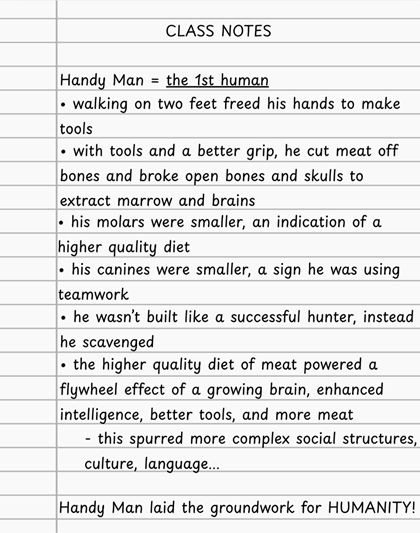
“Homo habilis, Latin for Handy Man, was the first to hold the distinction of being human. Handy Man used his hands to make stone tools, so he could exploit the necessary resource to survive—meat.
“Toolmaking for meat exploitation is a defining human trait. As you’ll see, meat became the epicenter of our other genus-defining traits, such as body and brain size as well as our dental structure. Handy Man’s humanity can be seen in his teeth. See here,” said, Dr. Whitt pointing to his back teeth, “how his molars were smaller. Who knows what that means?”
Rachel let go of Jason’s hand under the table to raise it and answer the question. “It means he was eating a higher quality diet. Less need to grind on tough vegetation.”
“Exactly. And his canine was also smaller. Who remembers what this means?”
A voice from the other side. “Evidence of more cooperation instead of conflict and competition.” It was Anna, blonde, blue-eyed, easy on the eyes.
“Right. And this is how he got his name,” Dr. Whitt pointed to the hand fossil. “He used his new precision grip to pick up stones and smash them together, to make the first truly complex tools.”
“Bipedalism enabled a more energy-effective means of venturing further from the forests. This had an unintentional consequence.” Dr. Whitt walked down an aisle of the lab, shaking both hands in the air. “Any guess to what this enabled?”
Chris waved his hands in the air. He was on the other side of his energetic pendulum. “It freed up our hands.”
“Right-o,” Dr. Whitt said. “With free hands, Handy Man could make and use tools.
“The first, most primitive stone tools begin to show up in the fossil record 3 million years ago in Kenya and Ethiopia. By two-and-a-half million years ago, Handy Man was striking one rock against another and creating razor sharp flakes that could slice meat right off the bone.” Dr. Whitt picked up what looked like a rock with a sharp edge. “He also used heavy-duty choppers to pound bones, smash them open, and extract marrow. Handy Man created a stone-tool industry called Oldowan, named after the discovery of these tools from the famous Olduvai Gorge site in Tanzania.
“Handy Man’s ingenuity marked the first known technological leap in human history. Manufacturing tools instead of relying on nature’s unchanged tools—such as stones and sticks—was a turning point. Our ancestors became active shapers of the environment, unlocking foods previously out of reach. Unlocking these foods was the key to humanity.”
The skeptic in Kevin arose. He raised his hand. “How do we know Handy Man used these tools to eat meat? Couldn’t they be used as weapons or even to process plant foods?”
“Great question, Kevin,” Dr. Whitt replied. “When Handy Man sliced meat off the bone, the sharp stone would leave distinctive cut marks.” Dr. Whitt reached under the table and pulled out what looked like a leg bone of some animal. “See here,” he pointed. “In telltale places, Handy Man cut muscle and ligament attachments. Similarly, when he pounded bones to crack them open, the fracturing is different than trampling and weather patterns. The remains of these animal bones, with signature markings found in the same stratigraphy as Handy Man’s tools, reveal he was a butcher.” Dr. Whitt carried the leg bone over and put it on the table in front of Kevin. “Pass this around. Tell me what else you see.”
Kevin passed the leg bone to Molly. She ran her fingers over some indents, replying, “It looks like there are also teeth imprints.”
“Excellent observation!” Dr. Whitt exclaimed. “Consider the situation. Those aren’t Handy Man’s teeth imprints. And he wasn’t throwing the bones to the dogs. Not yet. He wasn’t built like an apex predator either. Instead, do you know what these teeth imprints imply?”
“That another animal also ate off these bones.” Anna chimed back in, beating Molly to the punch. Kevin glanced at Molly and caught her glower.
“That’s right. These teeth imprints show that Handy Man let another carnivore make the kill. After, he could swoop in for the leftovers.
“So, Handy Man was a scavenger,” Kevin said.
“Indeed. He scavenged, transported, and butchered animals.”
“Wouldn’t eating rotting carcasses make you sick?” Kevin asked as he tried to wrap his head around Handy Man’s situation.
“You bring up a great point,” Dr. Whitt said, pointing his index finger in the air. “Natural selection is strongest when the going is tough. It’s those who are better equipped in tough times that survive and pass down those survival-advantage traits. This means ‘fallback foods’ are strong forces of natural selection.”
Kevin remembered discussing this exact point with Molly in the library. He glanced at her but found her staring straight ahead, completely unaware of him.
“Handy Man ate plant-based foods,” Dr. Whitt continued. “But as weather changed and plant-based resources diminished, his fallback food—animals—became increasingly important.
“You can see the evidence for this in your stomach today. It’s acidic. Very acidic. About one thousand times more acidic than your close relative, the baboon. Acidic stomachs are common among carrion feeders and carnivorous animals, as the acid is a pathogen filter and aids in meat digestion. Does that make sense?”
“I think so,” Kevin replied.
“Great,” Dr. Whitt continued. “So, Handy Man wasn’t a natural born killer, but carnivores and strong stomach acid evolved to do the fighting for him. The acid killed pathogens that resided in the rotting animals he scavenged. Handy Man didn’t have to kill big animals. Instead, he transported previously killed animals to a central location where he could eat it over days, even weeks.”
The leg bone had made its way around the class and Dr. Whitt picked it up and took it back to the front. “Handy Man didn’t just eat meat off the bone. A staple food in Handy Man’s diet came in this natural packaging.” He lifted the leg bone. “The packaging was so good that most animals couldn’t get to it. It was also more insulated from insects, bacteria, and environmental factors that cause decay and rot. But Handy Man was clever. He used big choppers to open the package.” Dr. Whitt picked up a rock in his other hand. “This gave Handy Man a monopoly on one of the most nutrient-dense, energy-rich foods—anyone?”
“Marrow,” answered a harmonious group whisper.
“Exactly. Bone marrow. Handy Man was selective about which bones he picked. He focused on high-calorie parts, like this disarticulated long bone here,” said Dr. Whitt. He lifted the fossil. “Because they are rich in marrow.” Dr. Whitt set down the leg and pulled out an antelope skull with tool markings and fractures. “Brains, too.”
“Like marrow, the brain is fatty. It’s energy dense. And it’s enclosed in a skull, safe from other predators. It also contains key nutrients to grow a big human brain, nutrition reserved for anyone smart enough to get to it.”
Dr. Whitt put down the antelope and picked up Lucy’s skull from the small table with his left hand and Handy Man’s skull from the other table in his right for a side-by-side comparison. “Compared to Lucy, Handy Man had a much bigger brain, about 40 percent bigger. It was necessary to fulfill the cognitive demands of toolmaking, scavenging, and social cooperation required to survive in the changing and challenging environment.”
“On the surface, it appears Handy Man wasn’t built for success. He wasn’t the climber that his ancestors were. Nor was he an agile, fast, or strong predator. As an ex-tree-dwelling, plant-based eater and an awkward, ill-equipped hunter, Handy Man’s advantage was his brain. As Handy Man moved away from the plant-based foods, which require constant foraging and long periods of digestion, and more towards meat and marrow, he got concentrated nutrition that could build and sustain the higher energy demands of a bigger brain. Handy Man kicked off a positive reinforcing feedback loop. One that would spin for millions of years, catapulting his descendants, including you and I, to the top of the food chain. Can anyone tell me again how this feedback loop worked? What powered it?”
Kevin took a shot. “Handy Man scavenged,” he started. “He used tools to slice meat and access marrow and brains. The increase in nutrition fueled a larger brain. Enhanced intelligence led to smarter scavenging, better tools, and even more meat.”
“Perfect.” Dr. Whitt nodded. “Enhanced nutrition—meat—fueled the advantage that nature continued to select for: a bigger brain and more intelligence to become better and better at meat acquisition.
“Not only was this new source of food highly nutritious, but it also saved time. Handy Man’s ancestors, like Lucy, spent six-plus hours a day chewing fibrous plant foods. However, as Handy Man replaced plant foods with animal foods, his chewing time was cut in half. What do you think he did with the extra time?”
“He could pursue other things,” Molly answered, her arms crossed tightly across her body. “He had time to make tools and time to teach toolmaking.”
“Absolutely,” Dr. Whitt responded. “This spurred more complex social structures and cultural transmission. With his growing intelligence, Handy Man figured out social cooperation was a strategic advantage.”
Kevin couldn’t help but think how Molly made time to help teach him. He also wondered if they had a “complex social structure” developing. Something was definitely off today. No smiles, not even a glance. Did I say something wrong? He replayed their study session in his mind, searching for a misstep.
The ride home I’d declined?
“How do you think Handy Man shared, taught, and culturally transmitted knowledge?” Dr. Whitt asked.
“OOH-OOH-OOH!” Chris grunted, hand waving in the air, mimicking the vocalizations and gestures Handy Man might’ve used.
“Go ahead, Chris,” Dr. Whitt said, fighting a smile. “Tell us.”
“He could grunt, point, and probably even do primitive-type demonstrations.”
“Very good,” Dr. Whitt gestured to Chris. “These early forms of communication laid the groundwork for more complex language. Handy Man showed early signs of division of labor for acquisition, transport, and processing of animals. Cooperation was advantageous to defend and acquire resources. Altruistic behavior, like food sharing, developed. Handy Man learned that what’s good for the group is good for him. He noticed the needs of others. Empathy enhanced survival. The defining traits of humanity started with Handy Man, fueled by meat.”
Kevin looked down at his hand. His precision grip, a gift from Handy Man, grasped a pencil that had worn blunt from pages of notes. Handy Man used his grip to unlock marrow, Kevin used it to fill his brain with new knowledge, which he hoped would soon solve the mysteries of his oral and facial degeneration. But it was Friday and after a riveting week, he felt it was his duty to fully participate in their ritual.
“El Jimador, please.”
Looking into the glass, he saw John Frank again, but this time with hopeful optimism.
. . .
Is everything ok?
Kevin typed the phrase into his phone then paused. Second guessing himself, he hit the backspace key. She was acting different yesterday. He had planned to see what was going on at happy hour, but she never showed. The blinking cursor seemed to mock his indecision. Forget it. It’s probably just in my head.
Same place, same time?
He hit send. Last time, she texted him right back. But now, after five minutes, there was nothing. Ten minutes, still nothing. He started re-typing his original question. Midway, his phone dinged.
To study for the exam?
Phew.
No, to play poker!
Saturdays were for studying. She knew that, but he hoped that it would lighten the mood…if there was a mood to lighten. Or that she’d at least get the sarcasm. As smart as she was, sometimes jokes could get by her.
🙄 See you there.
Per usual, Kevin got to the library a few minutes early. Molly looked like she’d gotten there a few hours early. Kevin threw a deck of playing cards on the table with a dramatic flourish.
“So, what kind of poker are we playing?” she said, surprising him with her willingness to play around.
“I don’t think we’re allowed to play that in here,” Kevin teased.
Slightly red, Molly said, “Well, we better stick to study cards then.” She pushed the deck aside, but the smile lingered on her face.
“Right.” Kevin pulled out a set of blank study cards. On the front of one, he wrote What is the evidence for meat seen in Handy Man’s teeth? He held the card up for Molly to read.
“You’re a poet and you didn’t even know it,” Molly joked.
“Okay, I’ll start,” Kevin said. He wrote on the back of the card, saying the words aloud as he recorded them. “The higher quality diet meant less chewing, which meant smaller teeth, bucking the previous trend from Toumaï to Ardi to Lucy of relatively larger teeth.”
“I agree,” Molly said. “Compared to Lucy, Handy Man’s molars also have higher, sharper cusps, covered in thinner enamel. These molars are better suited to shear meat with scissor-like function than Lucy’s, whose flatter molars with thick enamel were designed to grind and crush harder foods. And, did you know, there’s another reason for smaller teeth too?”
Kevin did. For once, he knew the answers to one of Molly’s questions. But instead of answering, he pulled the energy drink out of his backpack and popped it open with his teeth.
“Clever.”
Kevin returned her smile. “Teeth are tools too. You can open a can, pop off a bottle cap, or rip tape. It’s like an extra hand.”
“When I sew, I grip the thread, which frees my hands to knit,” Molly said, before going into tutor mode. “Humans and animals alike use their teeth as tools. Beavers use their front teeth to cut down trees and strip bark to build dams. Many Arctic Indigenous people chewed animal hides to soften them to make clothing. Using teeth as tools can change their shape.”
“But the reverse is true too.” Kevin interrupted the punchline, so she knew he was still listening.
“Right. Using tools to replace the work of teeth can also change their shape, as they did for Handy Man. Instead of using his teeth to rip meat off the bone or bite through a femur to get to the marrow, Handy Man used flakes and chompers instead of incisors and molars.”
“Got it,” Kevin said. “Tools replaced teeth as a first line of food processing.”
“And this forever changed our teeth’s evolutionary trajectory.” Her reserve from yesterday was gone.
Kevin pulled out another blank study card. “Okay, on to the next topic.” Slowly writing, he read aloud: “What is the evidence for meat seen in Handy Man’s jaw?”
“Like the teeth, his jaws also shrank. Handy Man had a smaller, less robust jaw than Lucy.”
“It makes sense,” Kevin said. “Like you said, tools were doing a lot of the work that teeth used to. And a higher quality diet meant less chewing. Combining these two factors, you can see why the jaws didn’t have to work as much.”
“I agree,” Molly said. “It makes sense, too, since the teeth and the jaws are connected.”
Kevin could tell she had more to say about this and gestured for her to keep going.
“Teeth have roots covered in cementum. The periodontal ligament connects the roots to the jawbones. The muscles of mastication attach here.” Molly pointed to picture of Handy Man on her screen, to where the muscles attached to the jaw and skull. “This tooth-jaw-muscle complex tells of the mechanical demand of the diet. “A gorilla that eats a low-quality diet of tough vegetation needs large jaws with big chewing muscles, like the masseter and temporalis, to grind all day. In herbivorous animals, the jaw joint often allows for more lateral or circular movement, as seen in a cow’s side-to-side motion to chew grass. Aligned jaw joints for vertical up-and-down chewing are useful to slice through meat or crush hard foods, like nuts and seeds.”
Kevin opened and closed his jaw. Vertical, like scissors.
“Chewing also stimulates jaw and facial bone development,” Molly continued. “If you see a skull with large jaws, with big muscle attachments, and big molars with thick enamel, it points towards a diet that’s tough and requires a lot of chewing.”
“And the reverse is true too then,” Kevin said. “More gracile jaws with smaller muscle attachments and smaller teeth indicate a higher-quality diet that requires less brute force chewing.”
“Exactly, just as Handy Man displays compared to his earlier ancestors,” Molly confirmed.
“Okay, let’s recap,” Kevin said. “Handy Man used sharp stones instead of sharp canines, big pounding stones instead of big chomping molars. And unlike his ancestors, who needed big teeth and large jaw muscles to grind through a low-quality diet for six-plus hours a day, Handy Man upgraded his diet. He sliced meat. He had reduced chewing demand, both less time and effort needed. The combination of meat and tools equated to millions of fewer chews per year. The energy saved from less chewing plus the energy gained from meat, supported a larger, energy hungry brain. The flywheel spun, giving rise to ever-shrinking teeth and growing brains.” Kevin’s energy drink had kicked in. Too bad the library was shutting down.
“Well, I guess that’s a wrap,” Molly said.
They packed up, walked out of the building, and started to go their separate ways when a thought hit Kevin.
He looked back. “Hey!”
Molly looked back expectantly, maybe hoping for a poker game. “Yes?”
“You know what, never mind,” Kevin said. “I’ll ask Dr. Whitt during office hours.” Molly struck Kevin as the kind of person who went to bed early. He didn’t want to keep her.
“You sure?” She hesitated, keys in hand.
“Yes, thanks. Good night.”
“Good night.”
As they parted ways, Molly wondered about the poker game; Kevin wondered what happened to Lucy.
August 30th, 2009
Dr. Whitt’s Office Hours
The door was cracked open. Kevin looked through the side window and saw Dr. Whitt reclined in his chair, talking to another professor.
“He might be the one.” Kevin heard Dr. Whitt’s voice like a whisper through the door.
Not wanting to interrupt, nor stand awkwardly outside, Kevin gently knocked on the door.
“Come in!” Dr. Whitt called from inside. Because the weekdays were so full, between classes, labs, and seeing patients, Dr. Whitt held office hours on Sunday afternoon. Students could drop in with questions. So, there Kevin was.
As the other professor left, flashing a grin at Dr. Whitt, Kevin took a seat in front of his desk, which was covered in papers and artifacts. It was cluttered but somehow also organized, like a physical manifestation of his mind.
“How can I help you?” Dr. Whitt asked, sitting up, looking a bit white, like Kevin had heard something he wasn’t supposed to.
“Well, I wanted to ask you about Lucy. I just don’t understand what happened to her. I mean, I know she went extinct, but…was there no niche for her? Was she totally outcompeted by Handy Man?”
“The teeth in the family tree tell the story,” Dr. Whitt replied, returning to his reclined position in his chair.
“I know. From Toumaï to Ardi to Lucy, there’s a trend of relatively larger molars with thicker enamel to support a tougher diet on the savannah, compared to the fleshy fruits of the forests. This trend forked with Handy Man. He had smaller teeth and a smaller jaw.”
“That’s right. But I’m talking about the other branch.”
“The other branch?” Had Molly and I missed this?
“Yes, we will talk about it next week,” he said, seeing the concern in Kevin’s eyes. “There was another branch from Lucy’s family tree, Paranthropus, also known as the Nutcracker.” Dr. Whitt pulled out a skull from a lower cabinet, handling it with careful reverence. “You can think of him as Handy Man’s cousin. His very different non-human cousin. They were complete opposites. Just look at the size of his teeth and jaw!” Dr. Whitt pointed to the Nutcracker’s thick mandible, flared zygomatic arches—his cheekbones—which made space for big chewing masseter muscles.
“The Nutcracker continued the trend that started with Toumaï to Ardi to Lucy. He had even larger molars with the thickest enamel of them all. He had huge chewing muscles.” He pointed out the sagittal crest on top of the skull where the massive temporalis muscle attached.
“With teeth and jaws like this, he could crack open walnuts, hence his name, Nutcracker. And look here.” Dr. Whitt pointed to his front teeth. “He had small incisors. He wasn’t husking fruit in the forest. Isotopic analysis shows a strong C4 signal in his teeth, which suggests he and his cousin, Handy Man, shared the savannah, but they stuck to their own dietary niches. No butchered bones or stone tools are found with the Nutcracker.”
“So, his teeth were his tools?” Kevin stated as a question.
“That’s right. Handy Man started to rely on tools, whereas the Nutcracker relied even more on his teeth as his tools. Nutcracker chomped through a low-quality diet of fibrous tough plant foods, such as nuts, seeds, and sedges. Handy Man went for the meat, forking the diet and teeth trend, trading a big bite, for a big brain instead.
“So, Kevin, to answer your question.” Dr. Whitt returned to Lucy. “According to isotope ratios, Lucy had a more diverse diet than Handy Man and Nutcracker, balancing forest and savannah living.”
“But isn’t that the key to humans’ success? That our advantage is we can eat anything and therefore succeed no matter what nature throws at us?” Kevin asked.
“There’s a misconception that dietary diversity is a safe and successful strategy that enables a species to adapt to whatever is available. It’s like being a jack of all trades, but master of none. Lucy, more so than Nutcracker, balanced forest and savannah foods, meaning she was a jack-of-both, master-of-neither. If forced to complete exclusively in either, she would be outcompeted by specialists in that environment.”
Kevin had a puzzled look on his face, so Dr. Whitt tried to explain it another way.
“I can tell you like to lift weights, right?”
Kevin nodded. He loved lifting weights. Dr. Whitt could tell because Kevin was looking bigger, up twenty pounds, since they first met at the summer orientation.
“Imagine three kinds of weightlifters. One weightlifter does pushups every day. His goal is to do as many as possible. He can do a hundred in one go. The second is a powerlifter. He does bench press, focusing on one to three reps, using the heaviest weight possible. The third is a bodybuilder. He attempts to balance reps and weight, doing eight to twelve reps to focus on hypertrophy. The bodybuilder is like Lucy, trying to strike a balance. He can lift more weight than the pushup specialist, and he can do more pushup reps than the powerlifter. However, the bodybuilder can’t lift as heavy as the powerlifter, nor can he do as many reps as the pushup specialist, and if forced to compete exclusively against either, he is going to lose to the specialists. Does that make sense?”
“I think so,” Kevin said. “So, Lucy was a ‘bodybuilder,’ but the changing climate favored powerlifters and pushup specialists. Or in other words, Nutcracker and Handy Man in this example.”
“That’s right,” Dr. Whitt confirmed. “The changing climate pressures and the availability of different foods rewarded specialized savannah strategies. Lucy went extinct. Handy Man and Nutcracker specialized, one forking to the meat, the other to the vegetation. You can see the difference between the diets of Nutcracker and Handy Man by the divergence of their teeth and jaw sizes, as well as the unique chemical signatures written in their teeth. The Nutcracker had high strontium-to-calcium and barium-to-calcium ratios, consistent with herbivores that specialize in tougher plant-based foods, which aligns with his robust masticatory system. The chemical signature in Handy Man’s teeth showed lower ratios, and his smaller masticatory system reflected his shift to more animal-based foods.”
“Got it!” And Kevin really did. He felt a rush of understanding, like the puzzle pieces were finally clicking together.
. . .
As Kevin walked out the back door of the dental school and started home, he realized his entire life had prepared him for this moment.
He thought back to his undergraduate research. It was at a different school, on the opposite side of Missouri, in a different lab, the Quantitative Analysis Lab. In the basement of the science building, McGruder Hall, on the lab bench, he and his research partner filleted fish before dissolving them in acid. They used graphite furnace atomic absorption spectroscopy to determine their lead contamination and whether they should attend the church fish fries or not. Lead leaves its signature too.
Between Kevin’s research, chemistry and biology degrees, and now dentistry, his studies were all aligning to make sense of the language written in teeth.
Like the lead he found in Missouri fish, trace elements in teeth can tell you what those teeth were eating.
The human body requires dozens of micronutrients, including essential trace elements, that play vital roles in cellular function and overall health. They come from food and get incorporated into tissues like teeth.
For example, plants absorb minerals like calcium, strontium, and barium from the soil. Animals that eat plants will preferentially absorb and incorporate calcium into developing teeth and bones. However, strontium and barium will still tag along to some degree. The relative amounts of these elements reveal if an animal is eating more plants or meat.
Herbivores have more strontium and barium relative to calcium in their teeth. A carnivore that eats the herbivore will have lower ratios of strontium and barium relative to calcium. A carnivore that eats a carnivore will have even lower ratios of strontium and barium as they continue to get filtered out up the food chain. So, by analyzing these trace elements in teeth, you can see where on the food chain those teeth were eating.
The Nutcracker was on the bottom. He was vegetarian. He had trace element ratios consistent with herbivores, while Handy Man had signatures in line with meat consumption.
Lucy’s descendants split. The Nutcracker specialized in plants in an attempt to compete for dwindling plant resources. The writing was on the wall. It was a dead end. He went extinct. Handy Man took the opposite route. He took the fork to meat.
September 4th, 2009
Exam #1: The Handy Diet
You could feel the anticipation in the air. The only thing standing between the students and their long Labor Day weekend was their dental anthropology exam.
The exams were laid face down across the room. Kevin took his usual seat next to Molly. The fluorescent lights hummed overhead.
“Good luck,” Kevin said, catching Molly’s eye.
“You’ll ace it,” she said with a wink.
“You may begin,” Dr. Whitt announced, and the room suddenly went silent.
Kevin turned the test over. It looked short, just two pages stapled together. The first page was blank besides a single instruction at the top:
Describe the first human diet.
Kevin was hoping for multiple choice, but he liked writing. His pen hovered over the paper for a moment as he collected his thoughts, then he wrote:
The Handy Diet was the first human diet.
Handy Man’s teeth clearly indicate he was eating meat. He was scavenging and slicing meat off bones. He homed in on long bones and skulls, cracking them open for marrow and brains. What started off as fallback food became a persistent and growing portion on Handy Man’s plate.
Handy Man still ate plant matter too. Physical markings on his teeth and chemical signatures in them show he still had to grind through tough vegetation. However, for the 1 million years Handy Man walked the earth, nuts, seeds, and tough vegetation increasingly became the fallback foods to meat. Animals were the year-round staples. Handy Man had less opportunity for opportunistic fruit-eating. As forest gave way to savannah, the opportunity was meat. Not just on the bones, but inside them, which other animals couldn’t get to. Handy Man could, with tools rather than teeth. A sharp flake cut tight-clinging meat right off the bone. A hammerstone opened the tightly sealed package of bone marrow. It took brains. Which is exactly what the high-quality diet fueled.
Handy Man’s plate had ever-growing portions of sliced meat, bone marrow, and brains. The other side of the plate changed with the season. Next to the meat, he might have eaten seasonal fruits, gathered nuts and seeds, and foraged vegetation. As the ice caps grew, this portion shrank.
Kevin turned the page. Another blank one. Question #2 read:
Describe the “fork and flywheel” phenomenon.
He started writing again, the words flowing more easily now:
Climate changes forced the earliest hominins out of the trees and onto two feet in search of food. Longer foraging and scarcer food led Lucy to a fork in the road. She could continue straight or fork off on a new path.
The Nutcracker continued straight ahead, trying to eke out an existence grinding through vegetation with his huge, thick-enameled molars. But as savannah spread, that road came to a dead end.
Handy Man took the fork. This was the road to humanity paved by tools, powered by meat, and advanced by brains. Handy Man was the first human. He took the fork, literally and figuratively. He fashioned the “fork,” known as Oldowan tools, to access and acquire meat. The fork spun the flywheel.
Meat fueled a bigger brain. Enhanced intelligence resulted in better tools, organized social structures, and increasingly complex language, which facilitated more successful meat acquisition. Bigger portions of meat fueled bigger brains, which spun up more ingenuity, more meat, and a flywheel that would eventually catapult humans to the top of the food chain.
Handy Man laid the initial stones on the path of humanity. He created a technological innovation that forked biological evolution. You can see it in his teeth. As tools replaced teeth and meat replaced plants, his masticatory system shrank.
By engineering his environment, he expanded his diet, taking ‘The Fork,’ which drove a reinforcing feedback loop, ‘The Flywheel.’ He laid the stones on the path to the next ‘Early Human Diet.’
Molly and Kevin finished at the same time. It almost looked suspicious. They turned in their exams and walked out together before heading home for break. With a wave and a smile, Kevin forked left, Molly right.
While Kevin looked forward to a relaxing weekend back home, he was already looking forward to the next section of Dental Anthropology and discovering more about the Early Human Diet that led to good oral health, too. It was both his favorite class and the most frustrating. It was like an itch being scratched too slowly. He still wanted to know why he looked more like the weak-jawed John Frank than the chad-jawed Cro-Magnon. So far, Dr. Whitt continued to raise as many new questions as answers.
Did I need to change my diet?
For the millionth time?

I was a fat kid.
I’ll tell you more about it later. But I really didn’t like it. From a young age, I tried to eat a “healthy diet.” In the 1990s that meant eating lots of grains, six to eleven servings of bread, cereal, rice, and pasta. Then add five to nine servings of fruit and vegetables on top of that. You could have a couple servings of lean protein, like fish or chicken. But everyone knew—including my mom, who was a cardiac rehab nurse—that saturated animal fats were bad for your heart. Instead, vegetable fats were the “healthy fats.” Margarine instead of butter. Skim milk instead of full-fat dairy. Egg whites, toss the yolk. Soy instead of steak.
It didn’t work. By junior high, I was fed up.
I took a page out of Toumaï’s book. I decided I had to stand on my own two feet. To figure this out, I had to leave behind the safety of the known and venture out into unknown territory. I went hunting for answers.
Like Toumaï, I stumbled around like a lost two-year-old. I tried every diet and made up countless diets of my own, mixing macronutrients, matching foods, counting calories, restricting feeding windows. I once tried eating only nuts for a month. Yeah, pretty nuts. I was a guinea pig of perpetual dietary experiments.
It was an obsession.
My high school senior thesis was a fifty-page research paper on The Obesity Remedy. In college, I decided to major in chemistry and add on a minor in biology, so I could apply the sciences to fat loss and muscle-building. Over the years, I continued to put one foot in front of the other. Like Ardi, I became a bit more grounded.
By the time I enrolled in dental school, I thought I’d cracked the code to health and fitness. I was in the best shape of my life. Between studying for board exams and making dentures, I started a side gig writing a fitness blog and creating online diet programs.
In 2013 I graduated from dental school. I did some post-graduate training in dental sleep medicine (DSM), a niche area of dentistry focused on treating sleep disordered breathing, a condition that ranges from snoring to obstructive sleep apnea. After that I was out in the real world. Green, I started my own DSM practice. Before long, my naivety had me developing an intranasal device to help better treat my patients. During this time, I kept up my nutrition and training side gig that I had started as a dental student. I also kept practicing what I preached and became a nationally qualified physique competitor. I was like Lucy—but instead of balancing the forest and the savannah, I was balancing work and workouts. That was, until I hit a wall.
Like Lucy, I came to a fork in the road.
It was 2016. I was doing part-time pediatric dentistry to complement my DSM practice while I also developed the new medical device for my snoring and sleep apnea patients. I was playing a lot of roles: doctor, practice manager, product developer, test dummy. Work hours piled up. And for a doctor treating sleep disorders, I wasn’t sleeping all that great. My brain wasn’t working like it used to. I thought maybe it was because I was turning thirty soon. I was no longer a kid who could burn the candle at both ends.
As any classically trained doctor would, I turned to drugs. Caffeine. The pot of coffee worked. Until it didn’t. In the afternoons, I crashed hard. The fog in my brain was thicker than the fog in the Grand Banks off the coast of Canada. I needed the clouds to part, the sun to re-emerge. I longed for clarity, focus, and mental energy to support my internal drive and external to-do list. But my brain was like a sputtering engine. It was like I was trying to step on the gas pedal, but I was stuck in neutral. Perhaps I needed to fix my fuel system, I thought.
On another one of my cloudy days, the fog parted just enough to let a ray of light shine through. That’s when I decided to take inventory of my diet. It was bland. Lots of chicken breasts and vegetables. Okay, a whole lot of vegetables.
Vegetables are the ONE food group we can all agree is healthy. Eat as much as you want of them, as much as you can, even. They provide essential vitamins, minerals, antioxidants, fiber, and nutrients.
Right? I thought. I couldn’t believe I was questioning this.
As I looked at the plants around my office, I remembered something from a biology class. These plants, like most plants, were completely inedible. If I tried to, I’d get sick. Plants, like all living organisms, fight for survival in an evolutionary arms race. But since plants don’t have teeth to threaten or feet to flee, they evolved other mechanisms to survive.
Many plants are like chameleons. They can change the color of their leaves to blend into their surroundings. They can grow in places that are difficult for herbivore predators and insect pests to reach. Further, leaves can produce resins, saps, and waxes that trap insects. Leaves and stems can be covered with sharp prickles, spines, and thorns.
But most insidiously, plants have evolved an arsenal of chemical weapons. I know because I’ve felt their wrath.
One time, I broke out in a horrible rash. My face and neck were bright red. It was so itchy. But I hadn’t done anything out of the ordinary. Well, besides eating a mango for breakfast.
My brother had had a dinner party that night. Sitting around the dinner table, I could see my aunt and uncle trying not to stare. I told them not to worry.
“I think I’m just allergic to mangoes,” I half-jokingly reassured them. It was both a crazy assertion and yet the only thing I could isolate as a potential cause.
After dinner I stopped by a pharmacy to grab every anti-itch cream on the shelf. Nothing really worked. I suffered for a few days before the rash finally healed.
Years later, I had all but forgotten about mango face allergy. Walking through the grocery store, I saw a fire sale on mangos. So, I decided to grab a couple. When I got home, I cut one up and had a few bites. That night I nearly peeled my face off. My lips swelled and my face reddened. I looked like a tomato. I did have a mango face allergy! I wondered if it was possible, so I looked it up.
I was right…and wrong. While rare, some people do have an allergy to the proteins in mangoes. More commonly, people like me are allergic to its touch. Mango skin is covered in urushiol, an oil also found in poison ivy. Which is exactly what it felt like. Like I had eaten poison ivy. I will never touch another mango.
And that’s exactly the point: urushiol is a defense mechanism that discourages animals from touching the mango plant, from chewing on its leaves, bark, and fruits before they ripen. It’s an evolutionary adaptation to deter predation and protect themselves from herbivores.
All plants produce toxins to protect themselves from fungi, insects, and animal predators.
These chemicals attack predators in various ways. Some break into cells and kill mitochondria. Others use enzymes to interfere with metabolism. And some can give you tomato mango face.
After digging through my old biochemistry notes, I narrowed down thousands of potential phytochemicals to the major players, the ones studied and recognized as potentially harmful for humans. The ones potentially responsible for my slothy brain. Time for a new experiment.
No oxalates or phytic acid that could be stealing minerals. No plant lectins or enzyme inhibitors that could be damaging my gut or blocking nutrition. No glucosinolates or endocrine disruptors that could be messing with my hormones. No glycoalkaloids or cyanogenic glycosides that could be clouding my brain.
Then I started to make a list of off-limit foods. I stopped after a few pages, realizing where it was headed. I shortened the list to one word.
Plants.
But I knew I couldn’t live on just chicken breasts. I needed an energy source. Without plants, I’d have to eat animal fat. The solution was steak.
I knew it was crazy. I was dropping the one category of food everyone knew was healthy…for the one everyone agreed was decidedly not.
I reassured myself that this was just an experiment. Based on my twenty years of previous experiments, this was just another walk in the park. What’s the worst thing that could happen?
I took the fork.
**********
Continue Reading: Chapter 2: The Foundation of The Human Diet
Want to read more for free? Just sign up for the Saturday 7.
P.S.
Any thoughts or suggestions?
Please let me know in the comments below! I read them all!
12 Replies to “The First Human Diet”
Omg this was so good! I loved the story telling style while dishing out a ton of information like a science book. Very unique. I really want to put this in my physical book collection. I do hope you’ll release it one day!
Thank you, Josie! I will be released someday (…just will take a bit longer than I anticipated 🙂
Chapter 2 will be ready in just a few weeks!
This is so good Kevin. I am really grateful I get to read what you give us here and can’t wait to get the book. Hope you don’t mind if I incorporate some of this into a presentation I’m giving to some people who are desperate for answers to their illnesses. I love the story and how you’re incorporating different characters along with an education in proper human nutrition. Looking forward to more. FEED ME!
Thank you for the opportunity to read Chapter 1! It was throughly engaging and educational. I appreciate the way you develop and present the reasoning behind the interpretations made for what each skull tells us and the long bones. This is just great. And it’s an engaging human narrative as well. Like Eugene, I have been following you for years and appreciate all the YouTube videos and all the written work you have shared. I have often thought about going to UBooks and looking through the introductory Physical Anthropology textbooks. I suspect none of them would be as engaging as yours. When your book is completed it will be one of my “must own” books and one of my most treasured.
Since no-one mentioned it yet, i noticed a small typo: “staple” instead of “stable” isotope analysis. Otherwise a fascinating walk through prehistory and an engaging read. I eagerly await subsequent chapters. As an aside, I followed you for years, and try to work you into the conversation whenever the topics of diet, sleep, or oral health are broached. Keep up the good work, people desperately need to know this stuff.
Thank you for the proofing Eugene! Correcting it now 🙂
Also, appreciate you following along for so many years!!
Thanks for sharing Chapter 1. I thoroughly enjoyed reading it, and I look forward to reading the next chapter and completed book. I’ve been eating mostly keto-vore for the last 10 years, after eating the “SAD” for most of my earlier years (e.g, lots of carbs, fruits and vegetables). I have lifted weights for most of my life, and currently do functional fitness (CrossFit inspired workouts) and go surfing on the weekends. Although I no longer get cavities, I still get dental tartare at each of my dental check ups, plus I have some deep pockets in my gums.
Thanks Ed! Appreciate you taking the time to read and share the feedback!!
This is fascinating. I had never thought of teeth from an anthropological point of view. I was lucky enough to be born in South Africa, which exposed me to more of humanity’s history. My ancestral chain goes back to England – which might explain my face and teeth. My diet as a child was probably horrible and I have had a lot of cavities. Interestingly as I have embarked on a high beef and animal product diet i have found my teeth are less sensitive and stronger.
I’m looking forward to next week’s chapter.
BTW – what happened to Molly?
Thanks Dave! “What happened to Molly?” – well this is just chapter 1, so more to come 🙂
I absolutely enjoyed chapter 1! As a former teacher of literacy, I felt as though you were GT kids in my literacy class the way you emphasized the earnestness of raising hands and the way you looked at one another and wrote in third person. It just sat rather odd for me knowing that you are all adults in a serious post-secondary graduate educational setting.
But again, the thoroughness in the anthropological detail with the skulls and teeth examination was fascinating.
Thank you, Trish! Just a bunch of 21 year old kids not too unlike high school or college 🙂